
Hamilton’s new American Classic Cushion Mechanical H36129730 looks small on a specification sheet and much less conventional in a photograph. The case is listed at 34 by 34 mm, but a square does not occupy the wrist like a 34 mm circle. The useful buying question is therefore not whether 34 mm is “too small.” It is how the cushion shape, 38 mm lug-to-lug span and 8.1 mm thickness work together.
Hamilton announced the collection on 1 October 2026, exactly a century after the Cushion Plain and Cushion Engraved models that inspired it. The black-dial H36129730 is priced at US$995 and listed as available soon in the United States. More important for collectors, it introduces the slim hand-wound H-42 and gives Hamilton a genuinely compact mechanical dress watch without treating smaller proportions as a lesser specification.
Thirty-four millimetres is only the first clue
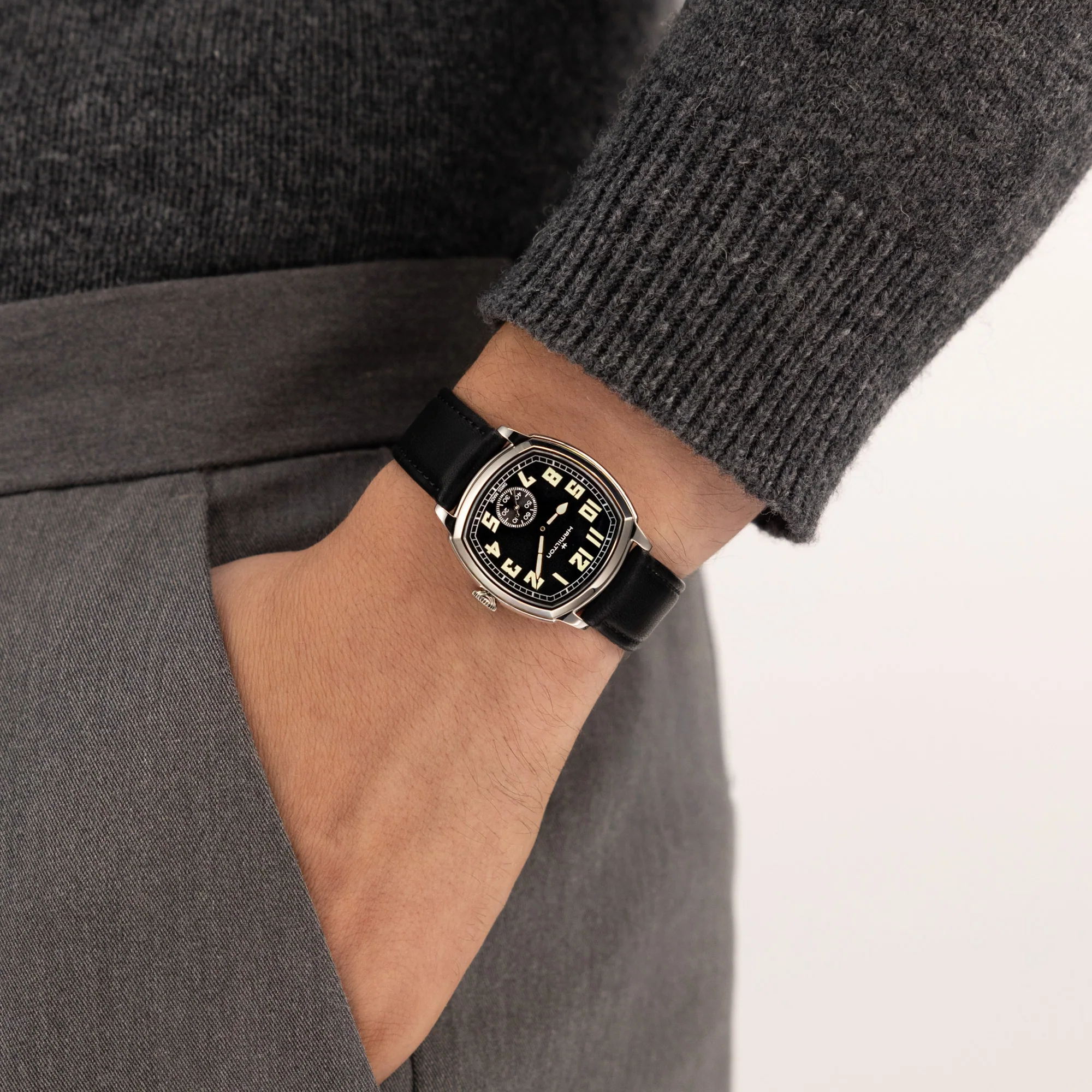
A round 34 mm watch is defined by a 34 mm circle. A 34 mm square carries material into its corners, so it can read broader across the wrist even when the number is identical. Hamilton controls that extra visual area with a 38 mm lug-to-lug length, short lugs and an 18 mm strap. Those measurements suggest a compact footprint, but Horomag has not handled the watch; comfort and real-world presence still require a wrist test.
The point is not to turn geometry into a universal fit formula. It is to reject diameter as a complete answer. The official wrist image shows the case as a framed object with curved sides, not a flat square. Buyers with smaller wrists should compare the 38 mm span and strap drop with watches they already know rather than assuming the 34 mm label tells the whole story.
Art Deco survives because the dial has a job
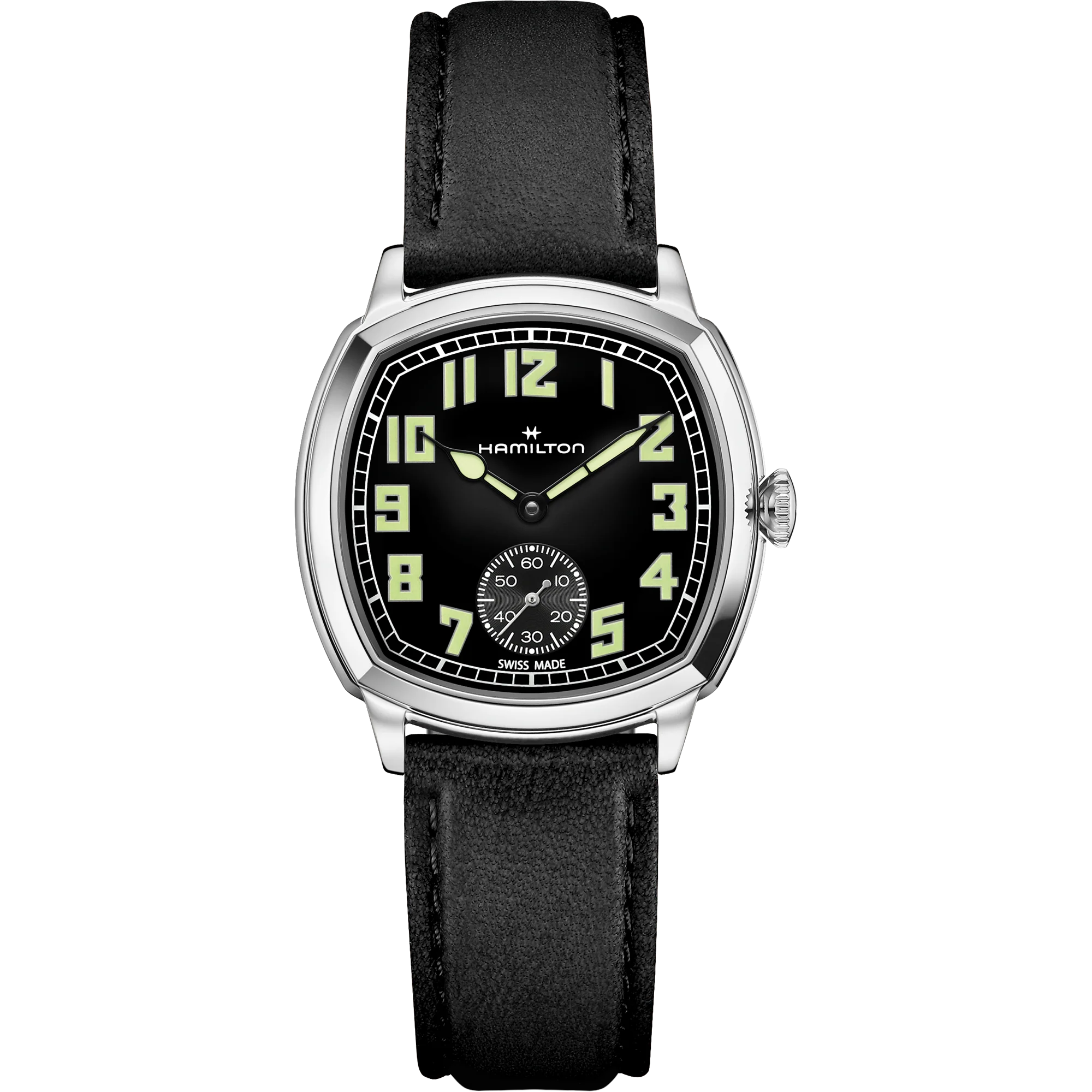
The oversized luminous numerals bend the eye around the cushion outline. A railroad minute track holds the composition together, while the small-seconds register at six o’clock makes the hand-wound movement visible in use. The design is referential, but it is not a museum copy: sapphire crystal, anti-reflective treatment, Super-LumiNova and 50 metres of water resistance make it a modern daily dress watch rather than a fragile costume piece.
The black dial is also the most assertive version of the family. It reduces the jewellery effect of the polished steel case and lets the pale green numerals carry the period character. Collectors drawn to the 1926 connection should still buy the contemporary object in front of them, not an imagined vintage reissue.
The H-42 makes the proportions possible
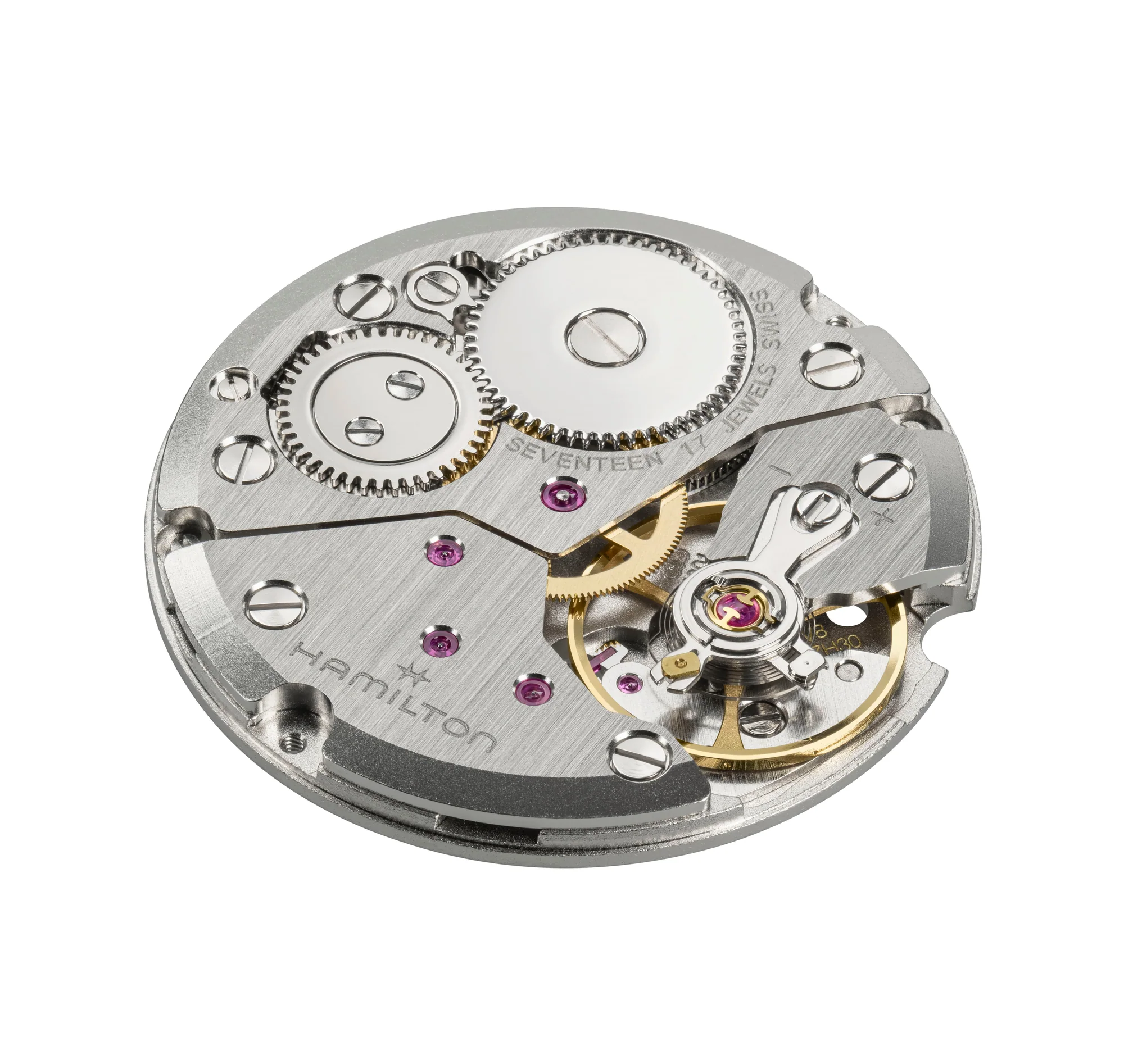
Hamilton says the new H-42 is based on the ETA 7001, itself descended from the Peseux 7001 architecture introduced in the 1970s. Its slimness helps the Cushion Mechanical stay at 8.1 mm thick. The movement adds a Nivachron balance spring and a 57-hour power reserve, long enough to leave the watch for a day without immediately losing the time.
That makes manual winding part of the ownership proposition rather than a nostalgic inconvenience hidden by the copy. The owner has to interact with the crown, and the small-seconds display confirms that the watch is running. Anyone who wants automatic convenience should treat that as a real trade-off, not a flaw discovered after purchase.
- Reference
- H36129730
- Movement
- H-42, hand-wound
- Case
- 34 × 34 mm; 8.1 mm thick
- Lug-to-lug
- 38 mm
- Power reserve
- 57 hours
- Water resistance
- 50 m
The buyer read
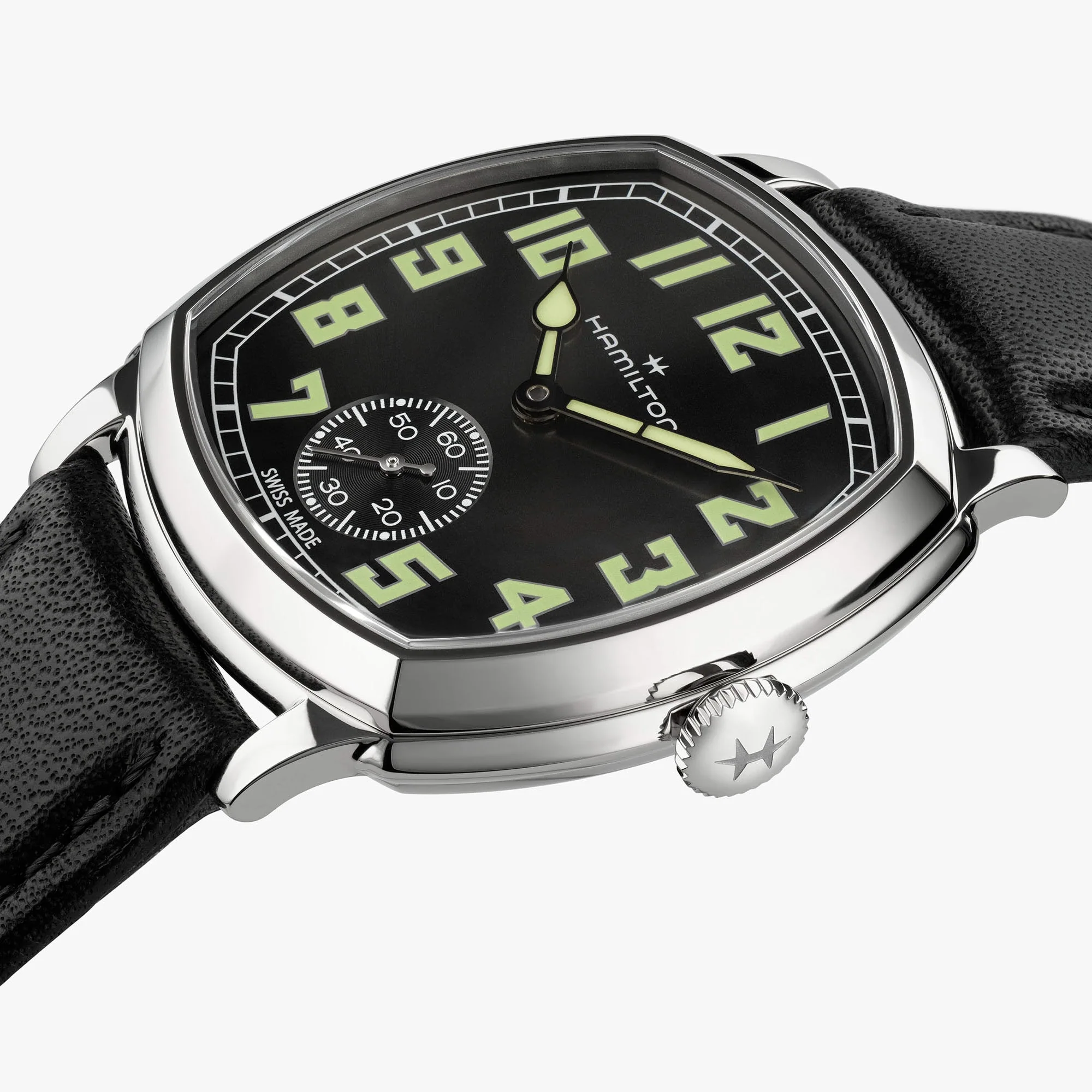
The H36129730 is most convincing when read as a shaped dress watch for buyers who want compact dimensions without visual timidity. The square footprint gives it more presence than the diameter suggests; the slim hand-wound movement keeps that presence from becoming thickness.
Buy it if the act of winding is part of the appeal, the black dial suits your wardrobe, and a 38 mm lug-to-lug span matches your wrist. Pause if you need automatic convenience, stronger water resistance or a case that disappears under every cuff. Hamilton’s real achievement is not making a small watch. It is making the word “small” too imprecise to describe what this shape does.


Loading comments...