
The quick answer
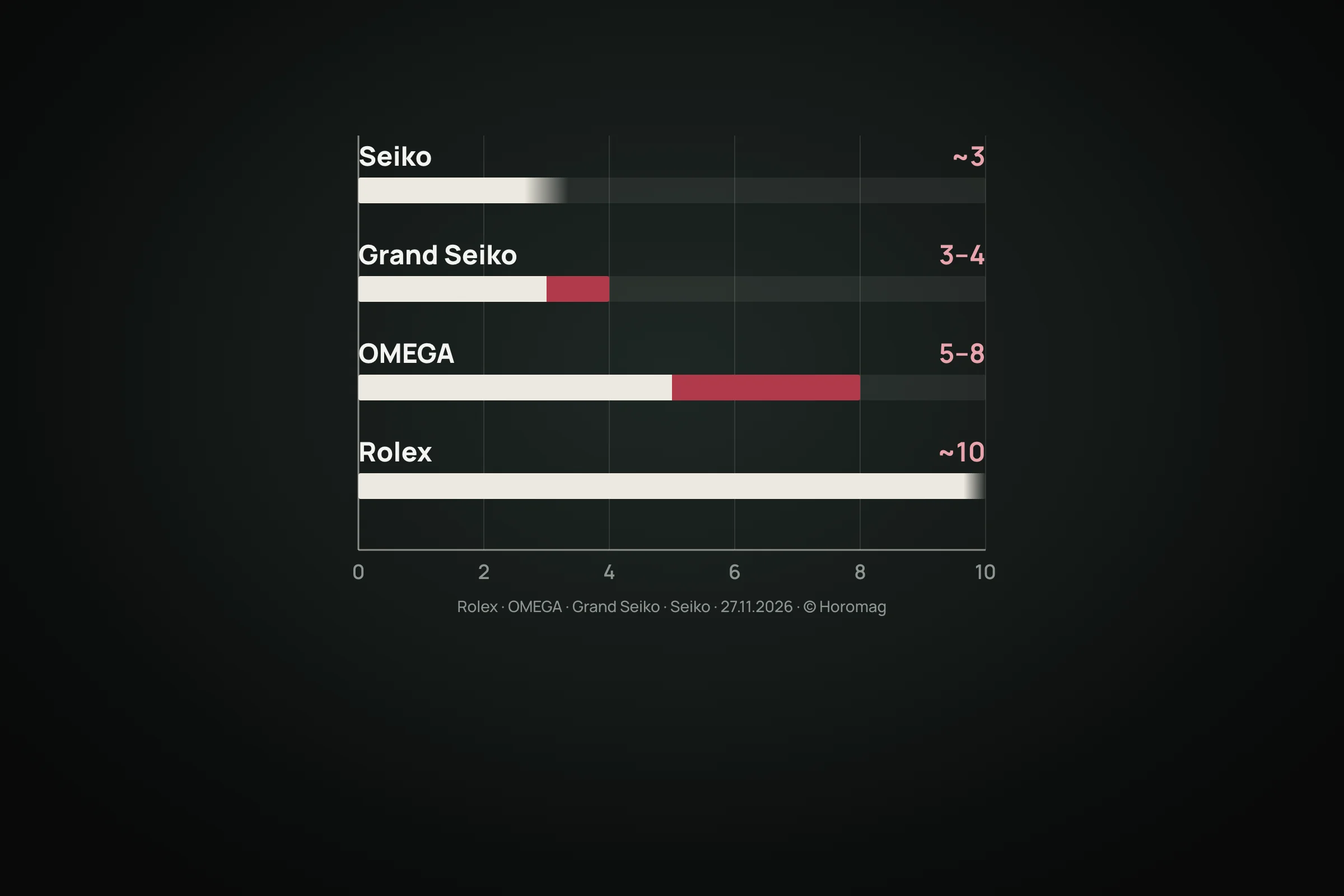
Use your maker’s number, not a forum average, and treat it as a ceiling for a watch worn hard rather than a target. Rolex recommends a service approximately every 10 years, depending on the model and how it is used. OMEGA recommends a complete service every 5 to 8 years. Grand Seiko asks for an overhaul every three to four years, and Seiko recommends one about every three years. Whatever the interval, have water resistance checked more often if the watch meets water: OMEGA suggests once a year.
Those figures look like a ranking of durability. They are better read as four different statements about the same three things.
What the interval is protecting
Every maker in this guide describes the same job. Seiko puts it plainly: worn movement parts and aged oil can make a watch lose time or stop, and water resistance is not permanently guaranteed, because gaskets age and a knock can deform parts. Grand Seiko’s Spring Drive instructions add a useful detail. Its regulator wears less than a mechanical escapement, yet the gear train still runs like any other, so the overhaul interval stays at three to four years.
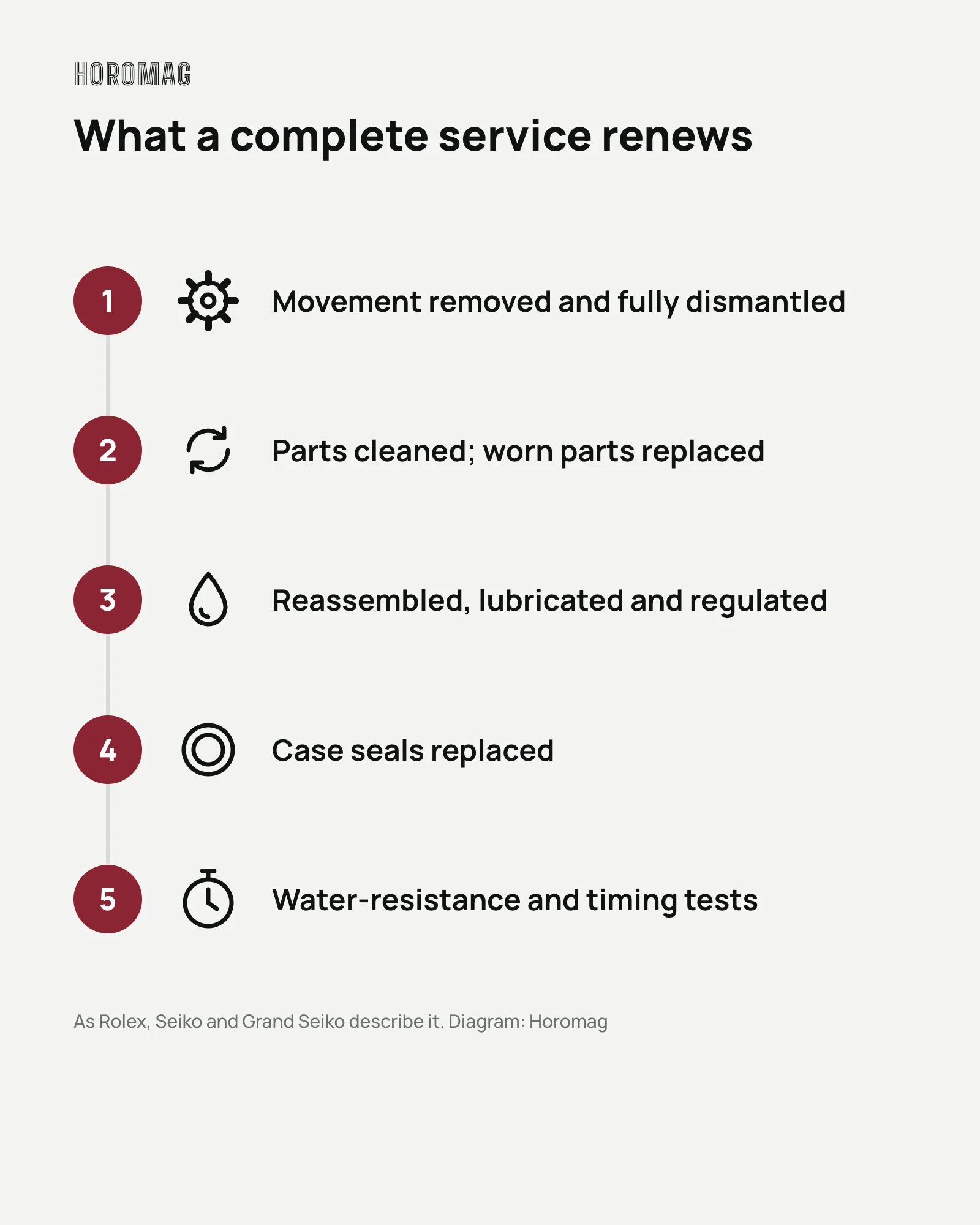
Rolex’s description of a complete service shows what the visit actually involves. The movement comes out of the case and is taken apart completely. Parts that no longer meet Rolex specifications are replaced, the rest are cleaned ultrasonically, and the movement is reassembled, lubricated and regulated. The case is dismantled, its seals replaced and its waterproofness tested, and the finished watch runs a Rolex test of at least 24 hours before it goes back.
Why the numbers are so far apart
The brands do not publish the chemistry behind their schedules, so what follows is our reading, not theirs. An interval is partly engineering confidence in oils, seals and wear surfaces, and partly policy about how much risk the maker wants an owner to carry between visits.
Grand Seiko is the most explicit about its reasoning. Its mechanical instructions say the first three to four years are when parts wear in against each other and shed extra metal powder, and they call the first overhaul the key to the watch’s life. That is an argument for servicing early once, not for servicing often forever.
Rolex’s 10 years comes with the brand’s own qualifier, “depending on the model and real-life usage.” A diver used in salt water every weekend and a dress watch kept in a drawer are not on the same clock, and none of these pages says otherwise. OMEGA’s range of 5 to 8 years makes the same point by being a range.
What a service costs, where the price is printed
Of the four, Rolex is the one whose complete-service prices we found listed openly, on its US site. They are fixed by model group, and estimates are free.
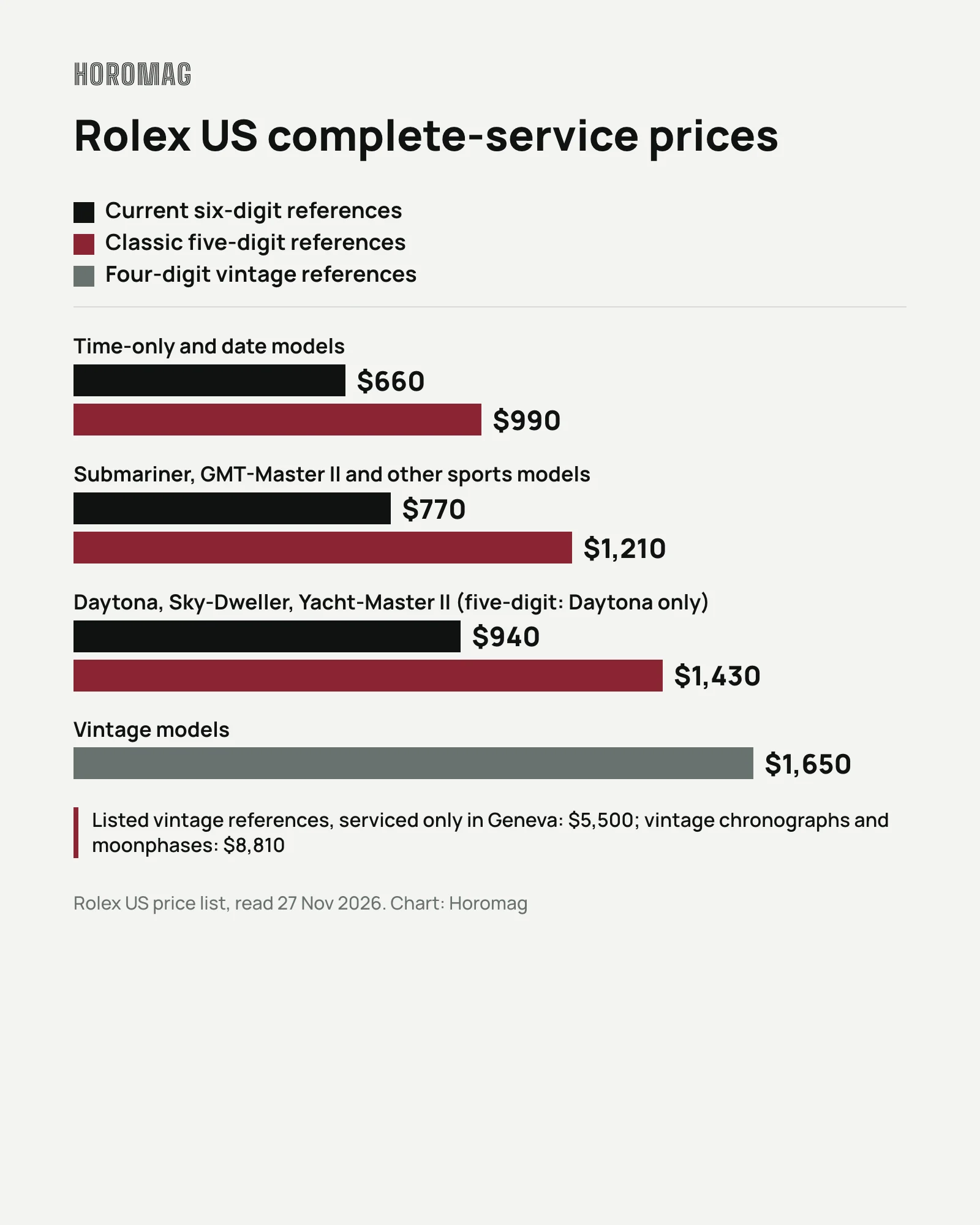
For current six-digit references the price is $660 for most time-only and date models, among them the Datejust, Day-Date, Explorer and Land-Dweller. Explorer II, GMT-Master II, Submariner, Sea-Dweller and Yacht-Master cost $770, and the Cosmograph Daytona, Sky-Dweller and Yacht-Master II $940. Polishing and satin-finishing of case and bracelet is optional at $170.
The older the reference, the higher the bill. The same families in five-digit form cost $990, $1,210 and $1,430. Four-digit vintage models cost $1,650, and a list of vintage Cosmograph, Submariner, GMT-Master, Explorer and other references costs $5,500. Only Rolex’s Restoration Atelier in Geneva may service those, and the vintage chronographs and moonphases on the list cost $8,810. Vintage wear parts are supplied “subject to availability”, work on the dial and hands is excluded, and an owner who declines the estimate pays a $280 analysis fee.
What the price list means for a pre-owned buyer
Here the interval stops being a maintenance note and becomes part of the purchase price. Take two Submariners at the same asking price, one a current six-digit reference and one a five-digit classic, with no service history. The older watch will cost $440 more to service at Rolex, and that is before any parts outside the standard list. Ask for the service date and paperwork, and if there is none, subtract the relevant figure from what you are willing to pay.
Guarantees matter too. A new Rolex carries five years. After a complete service Rolex gives two years on parts and labour, TUDOR gives a two-year service guarantee, and OMEGA gives 24 months on each intervention. A recently serviced watch with its service card is therefore worth more than the date alone suggests. Rolex’s five-year guarantee also excludes damage caused by opening or repair by anyone other than an official Rolex jeweller or service centre, so a cheap third-party service on a young watch can cost more later.
Mistakes to avoid
Servicing by the calendar alone. A watch that gains or loses noticeably, stops early on a full wind or shows condensation needs attention whatever its date.
Skipping the water test. Gaskets age between full services, which is why OMEGA separates a yearly water-resistance check from the 5 to 8 year service.
Polishing by reflex. Rolex lists case refinishing as optional. On an older watch, sharp case lines can matter more to a collector than a bright finish.
Assuming every watch can be serviced as normal. For vintage models Rolex may refuse a complete overhaul and offer a Restoration estimate instead, and declining that costs $2,200.
Before you book, or before you buy
- Find your maker’s own interval for your calibre: about 10 years at Rolex, 5 to 8 at OMEGA, three to four at Grand Seiko, about three at Seiko.
- Check water resistance yearly if the watch swims, and after any knock.
- With a new Grand Seiko, plan the first overhaul in years three to four.
- With a pre-owned watch, ask for the last service date and invoice, and price an overdue service into your offer.
- Ask whether polishing is included and decline it if you want the case left as it is.
- Keep the service card with the watch. It carries a guarantee and tells the next buyer what was done.

Loading comments...