
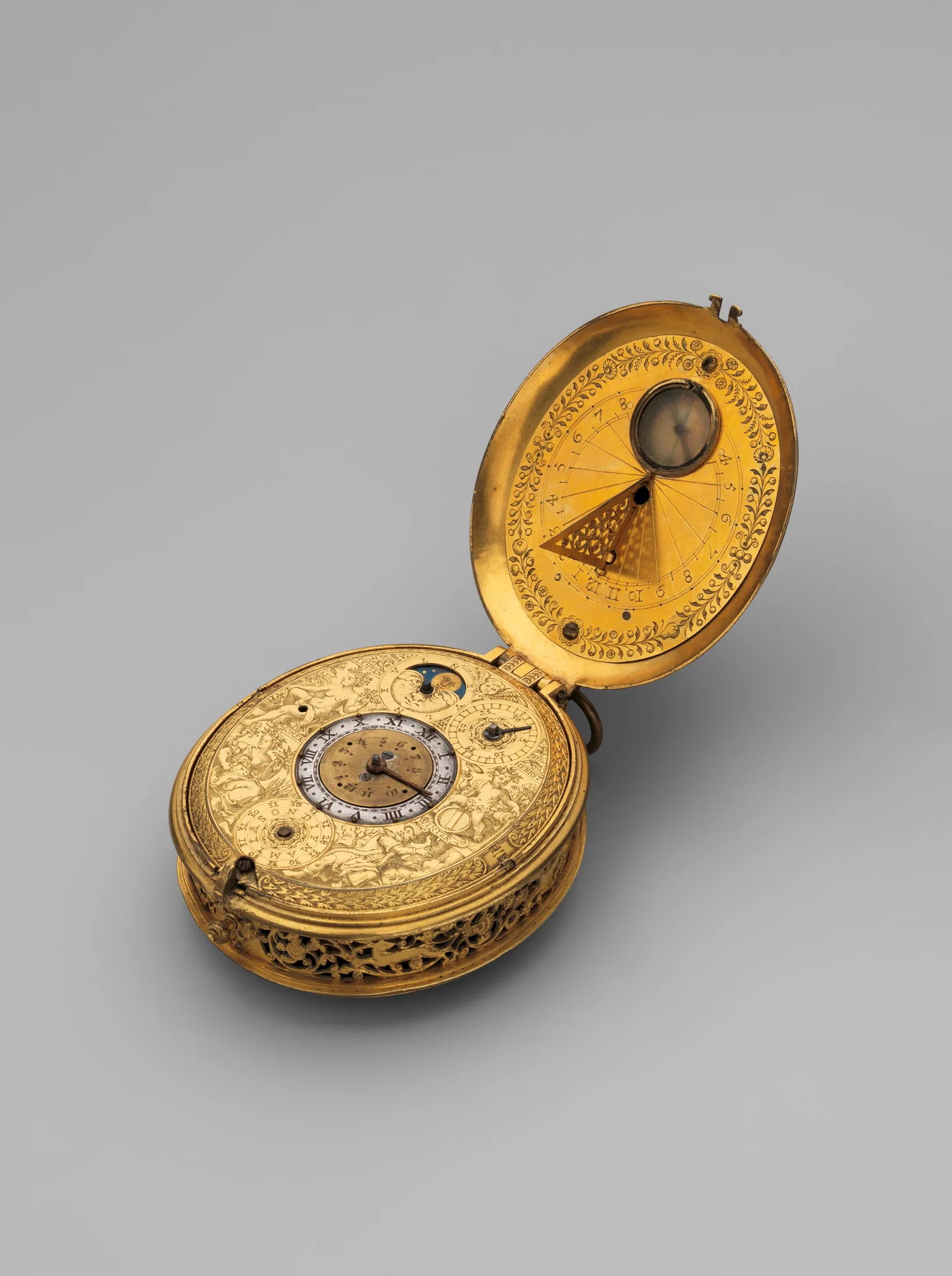
Open the lid of Jan Jansen Bockeltz’s clock watch and there are two instruments where you might expect one. The lower half has an engraved dial and a spring-driven movement. Inside the lid sits a sundial with a folding compass. The Metropolitan Museum of Art dates the watch to about 1605–10 and attributes it to Bockeltz in Haarlem. On a clear day, the part with no gears could help set the one powered by a spring.
A time check inside the lid
The Met describes the sundial as horizontal and usable at 42 degrees latitude. The compass helped orient it, and the raised piece on the sundial cast the shadow by which to read the hour. Opening the lid alone would tell you nothing: the shadow needed sunlight, the right orientation and a suitable latitude. The watch could run indoors or after dark. The sundial was useful outdoors when the watch needed correcting. Putting both in one case makes that division of labour visible.
What the spring-driven watch could do
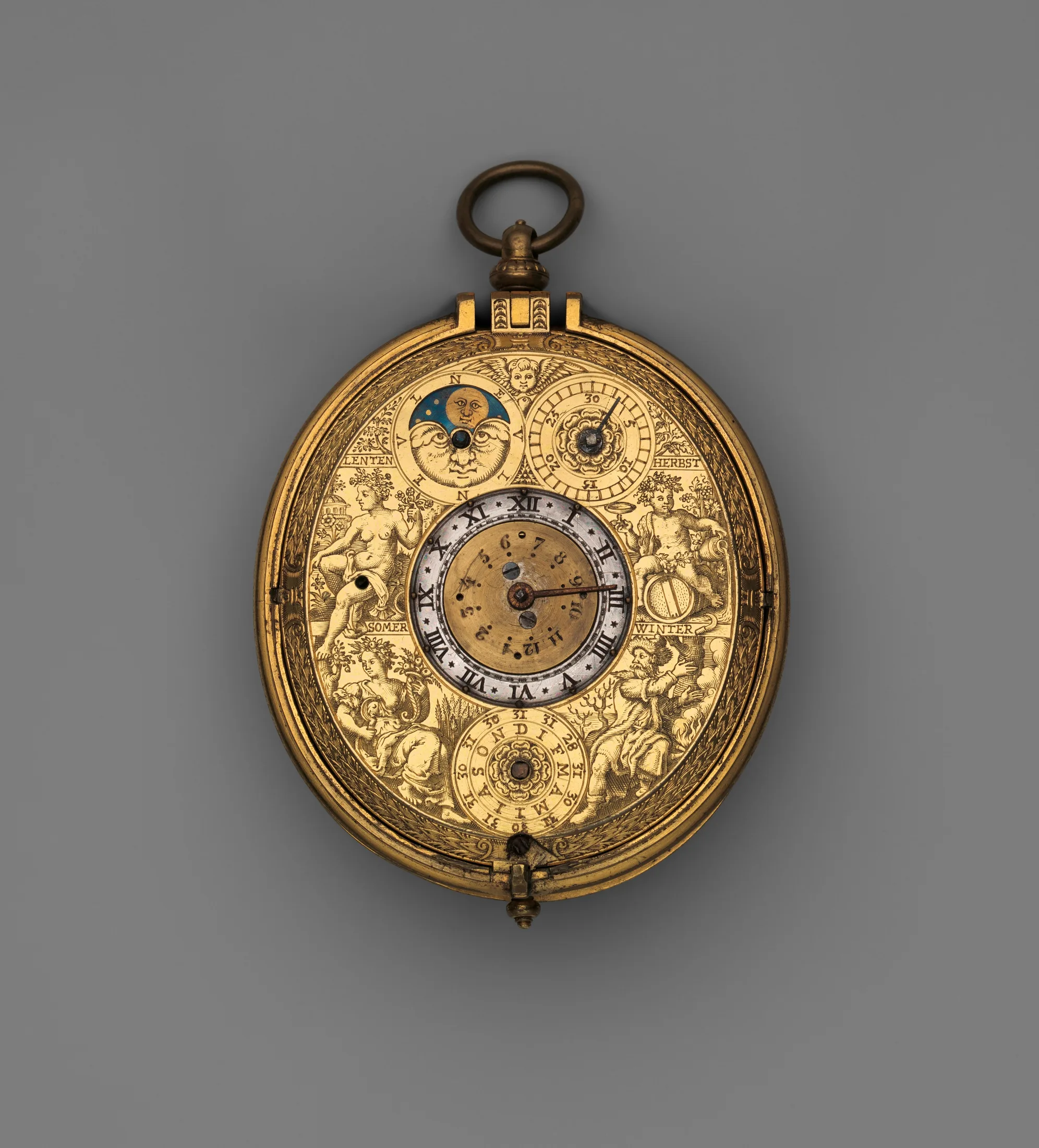
The central dial has a ring of Roman hours. The smaller indications show the phase of the moon, the day of the month, and the month with its number of days. Engraved figures of the four seasons surround them. The case held a bell for the hours and a separate alarm mechanism. A lever could silence the strikes. What appears at first to be ornament is also a way of giving each indication a distinct place on a crowded dial.
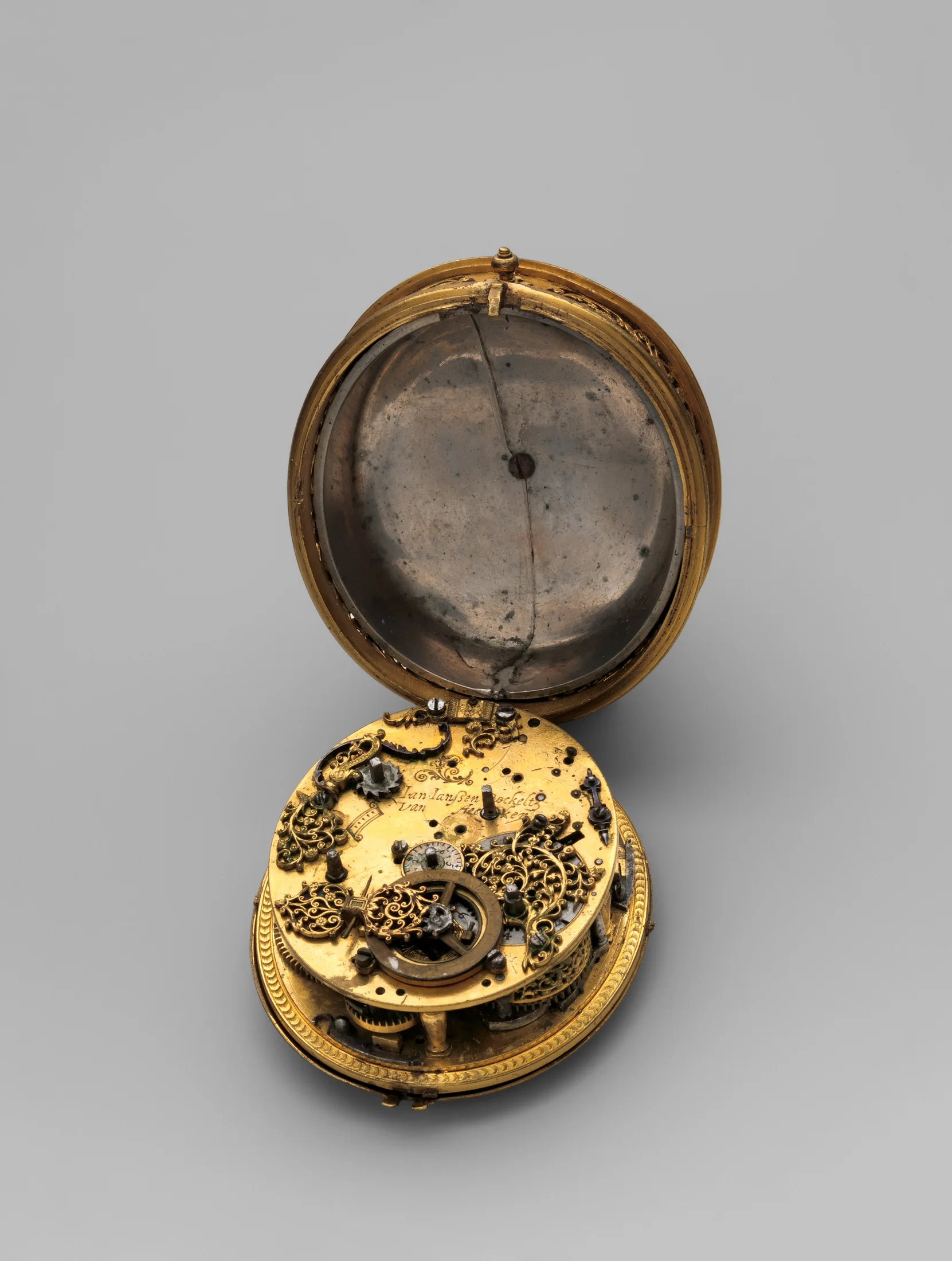
The Met identifies a verge escapement, which meters the movement’s advance, and a fusee, a tapered drum that helps even out the changing pull of the mainspring as it unwinds. The two do different jobs. The fusee changes the leverage through which the spring drives the movement. The balance and escapement govern how that drive is released. The Science Museum Group’s description of a fusee-cutting engine helps explain the changing leverage: the cord runs in a spiral groove on a drum whose diameter varies along its length.
The mechanism carries its own chronology
The watch now has a balance spring. The Met’s curators date its addition to after 1675 and link the change to the probable replacement of the earlier verge and balance. A chain took the place of the fusee’s original gut line. Neither hand is original, the bell is cracked, and the gearing for the month is missing. Even the present alarm-setting disc may date as late as the nineteenth century. The museum’s own description is a better guide to what survives than a glance at what the dial appears capable of showing.
Where to look when a watch has been altered

Start by separating the things the watch was built to do from the parts that now perform them. Then look for evidence that ties the case and movement together. The Met points to similarities between the pierced metalwork on the sundial and details of the movement, and records the maker’s signature on the back plate. That is a more interesting line of inquiry than counting replacement parts. The lid is still the best place to begin. It preserves the point at which the person carrying the watch could intervene, using a compass and a shadow to set a machine running on a spring.




Loading comments...