
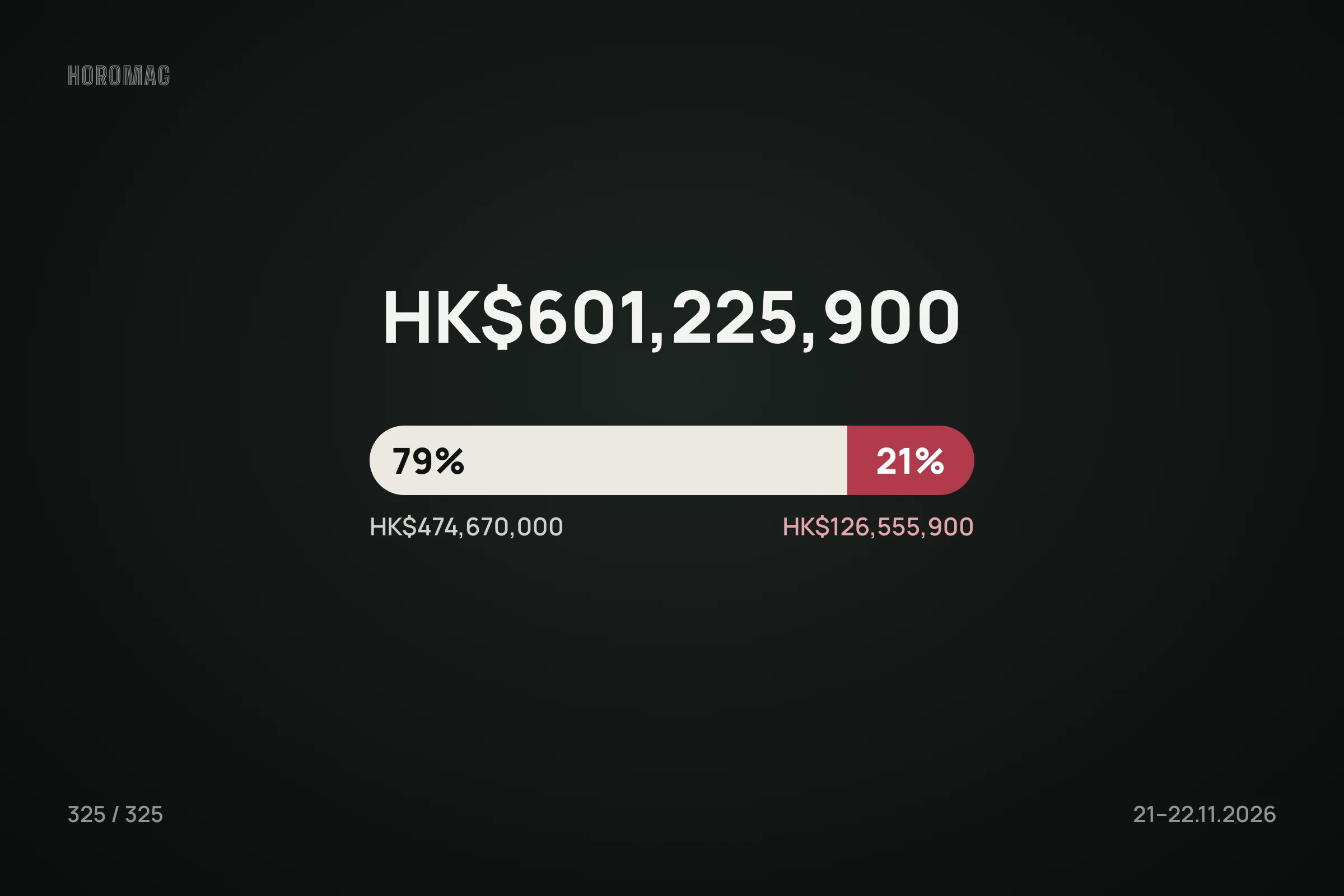
On 21 and 22 November 2026, Phillips in Association with Bacs & Russo sold 325 watches in Hong Kong for HK$601,225,900, about US$76.7 million at the house’s exchange rate. Phillips says it is the first watch auction in Asia to pass HK$600 million and the most valuable ever held in the region. Every lot offered found a buyer. The total, though, includes the buyer’s premium, and the estimates printed beside each lot do not. A collector who wants to use these results as a price guide has to put the two on the same footing first.
What Phillips reported
The Hong Kong Watch Auction: XXIII was sold 100 per cent by lot and by value. Phillips counted 1,800 registered bidders across 70 countries and regions. It said 35 per cent of participants were under 40 and 20 per cent of bidders were new to the house. Nineteen watches made more than US$1 million each, which Phillips calls a record for any auction house in Asia. The sale came two weeks after its Geneva auction, which the house reported at US$112.3 million.
The top price was HK$34,175,000 for lot 958, a Patek Philippe Ref. 2499 “First Series” in yellow gold with a case by Wenger, made in 1952 and sold in 1956. The catalogue says it had last appeared at auction in 1989 and describes the case as unpolished in the house’s opinion. The estimate was HK$12 million to HK$24 million.
Taking the premium back out
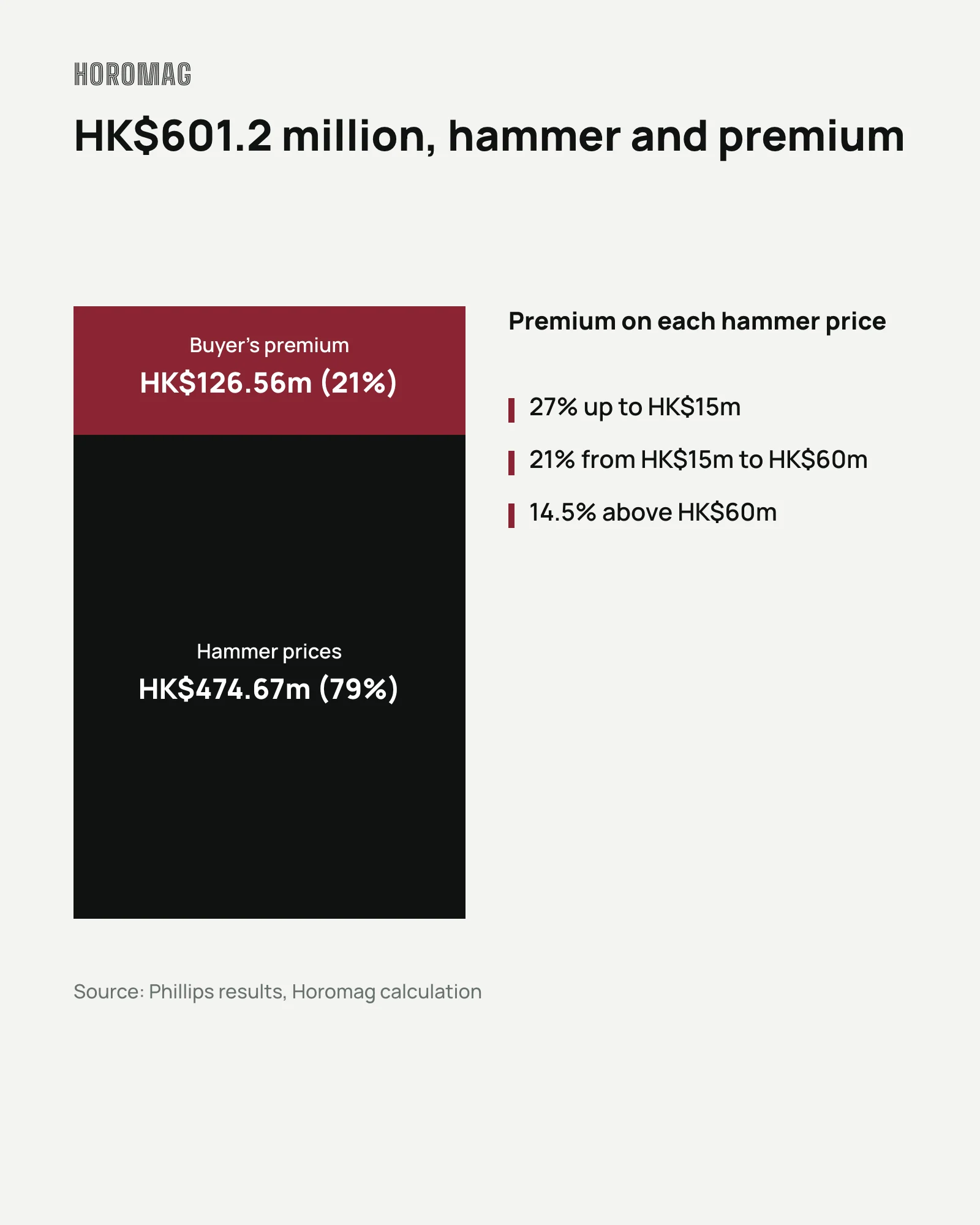
Phillips’ results sheet states the fee. The buyer pays 27 per cent on the hammer price up to HK$15 million, 21 per cent on the portion from there to HK$60 million and 14.5 per cent above that. Its guide for Hong Kong watch buyers adds that pre-sale estimates do not include the premium.
Work back through that schedule and the 325 hammer prices add up to HK$474.67 million. The other HK$126.56 million, 21 per cent of the headline figure, is premium. The Ref. 2499 was hammered at HK$27.5 million. That is still above its high estimate, by 15 per cent instead of the 42 per cent the published price suggests.
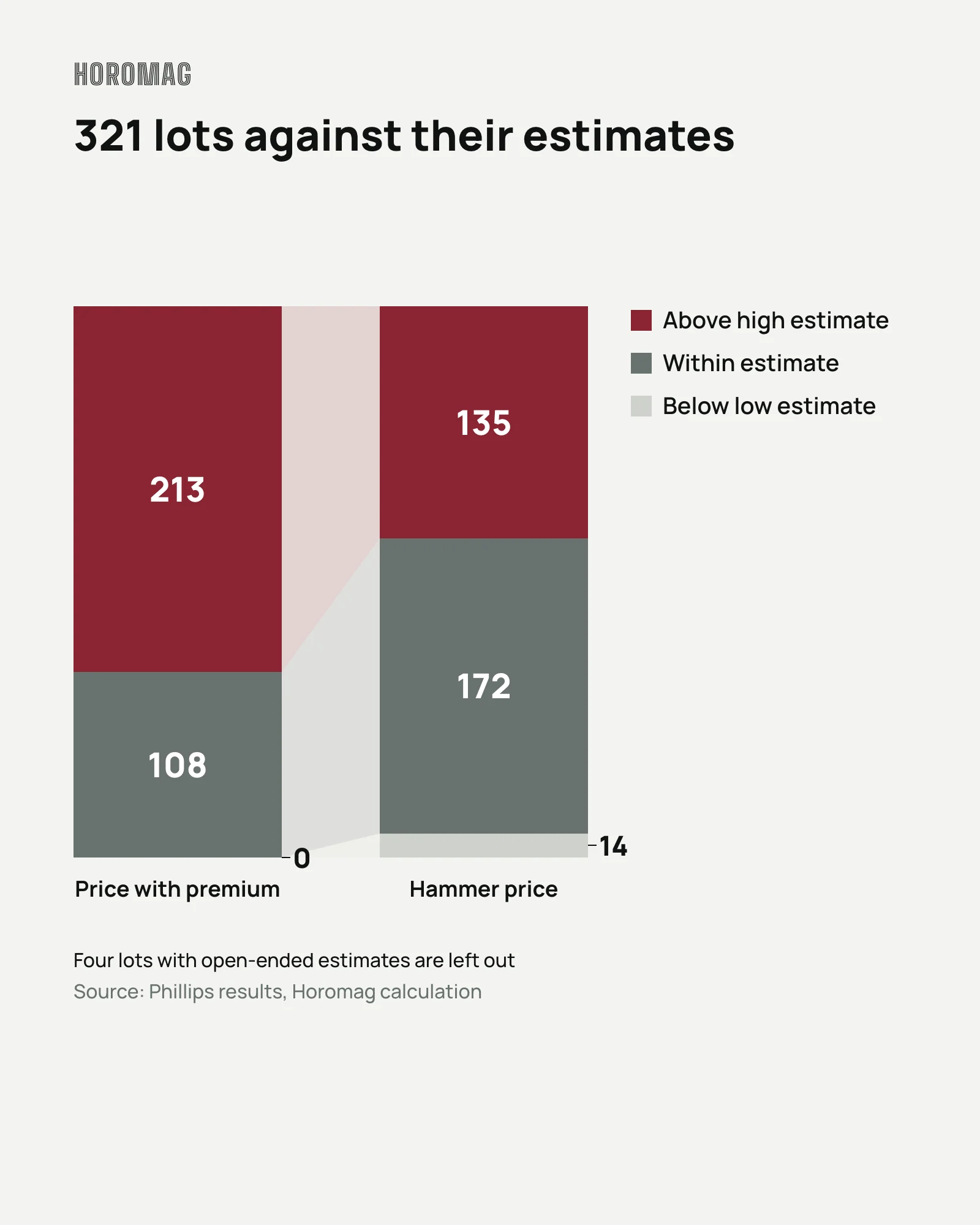
Across the sale the gap changes the count. Four lots carried an “in excess of” estimate with no upper figure. Of the 321 with a published range, 213 sold for more than the high estimate once the premium is included. At the hammer the number is 135. Another 172 were hammered inside their range and 14 below the low figure. So 78 lots went over the top of their estimate only because of the fee.
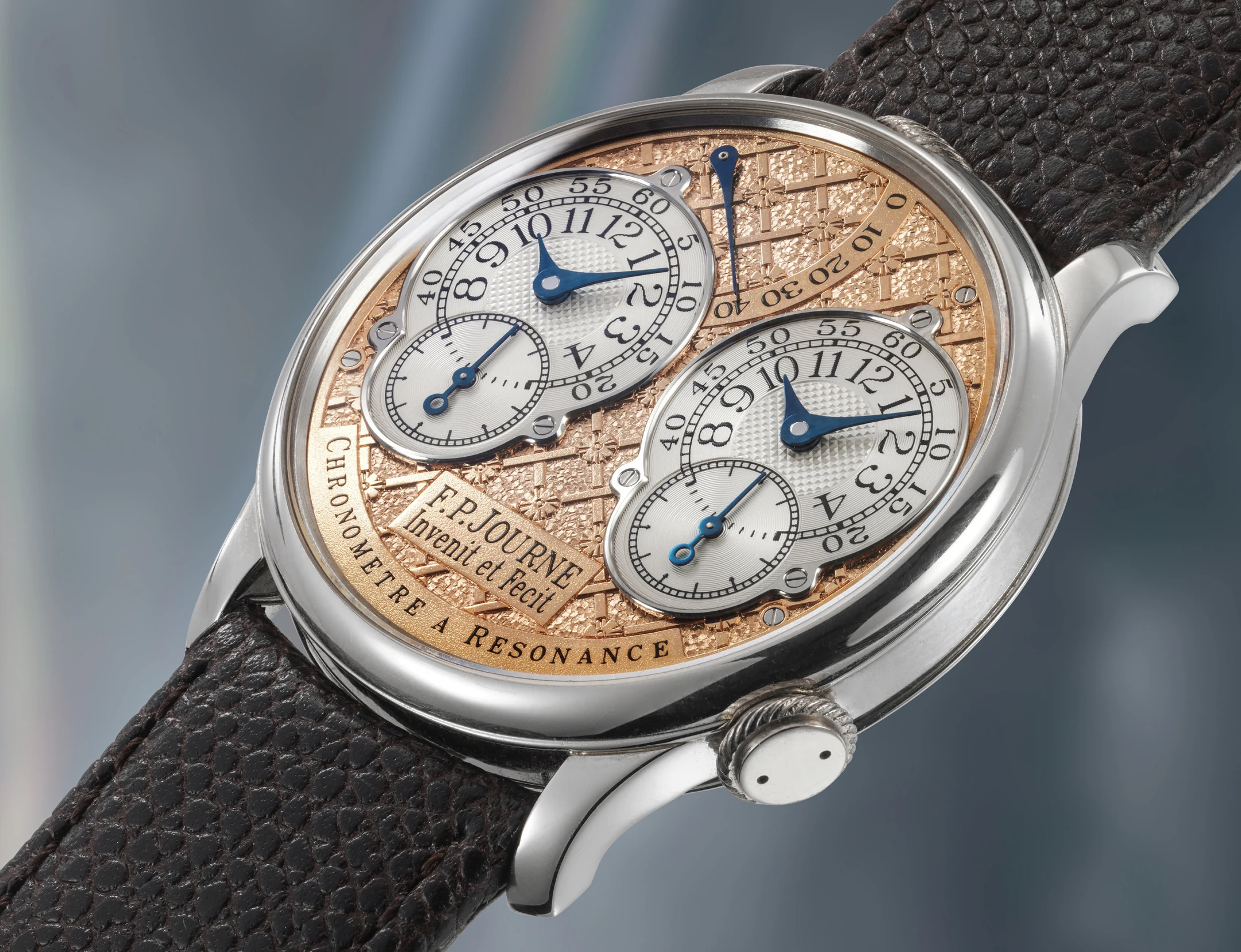
The same applies to the multiples in the press release. Phillips says an early F.P. Journe Tourbillon Souverain, No. 069/01T, sold for 2.5 times its high estimate at HK$28.73 million. The hammer price was HK$23 million, which is about twice the HK$11.6 million high estimate. A second early Tourbillon Souverain, No. 041/99T, shows the effect more plainly. Its published price of HK$11.43 million is above the HK$9.6 million high estimate. Its hammer price of HK$9 million is inside the range.
Two names, 65 per cent of the money
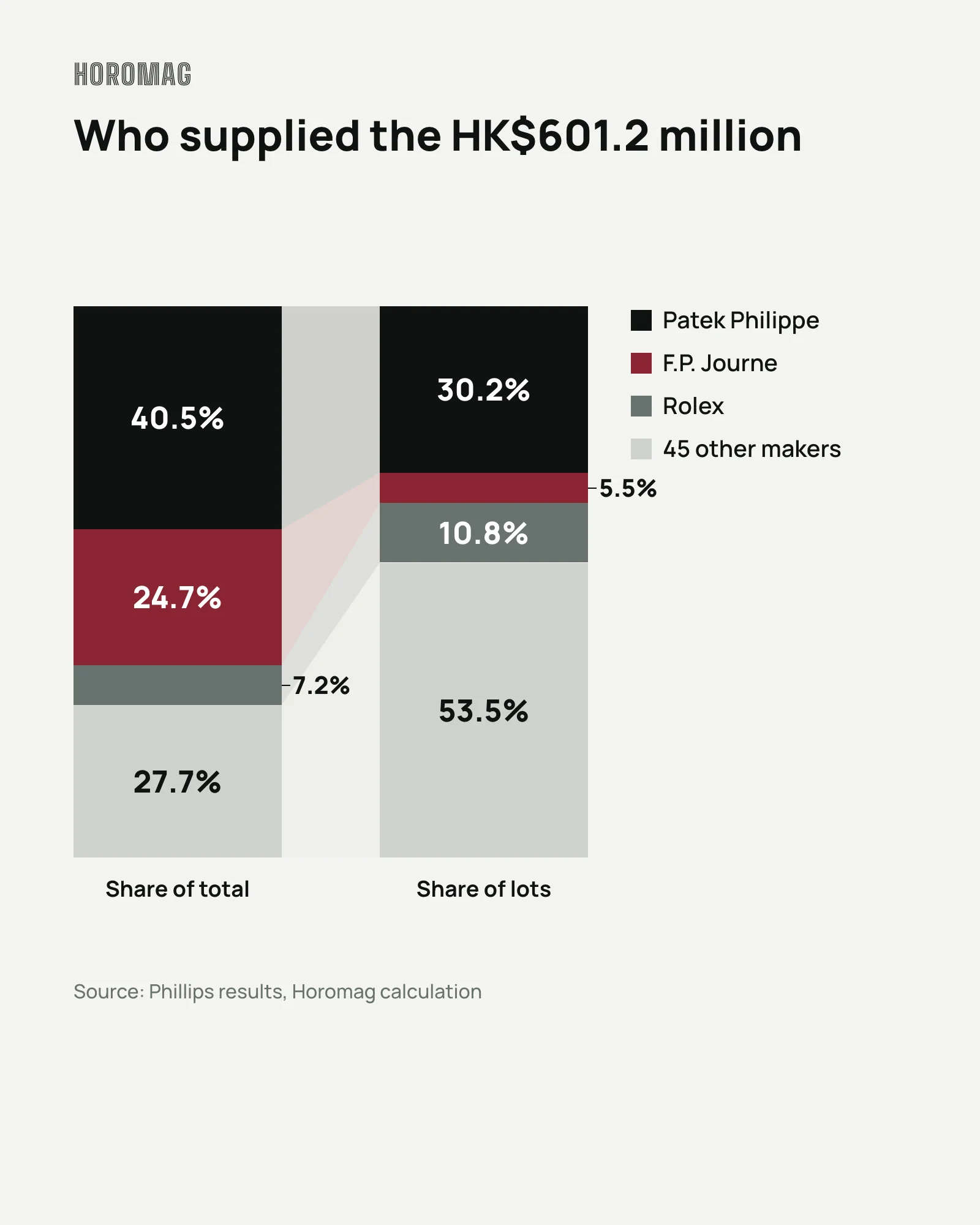
Forty-eight makers appear in the results. Two of them account for most of the total. The 98 Patek Philippe lots made HK$243.3 million, or 40.5 per cent. The 18 F.P. Journe lots made HK$148.5 million, 24.7 per cent of the sale from 5.5 per cent of the lots. Rolex, with 35 lots, contributed 7.2 per cent.
The 19 lots above US$1 million made HK$282.1 million between them, 47 per cent of the total. The median price was HK$635,000 with premium, and almost two-thirds of the 325 lots sold for less than HK$1 million. The record is a result for one layer of the sale, and the middle of the catalogue ran at a very different level.
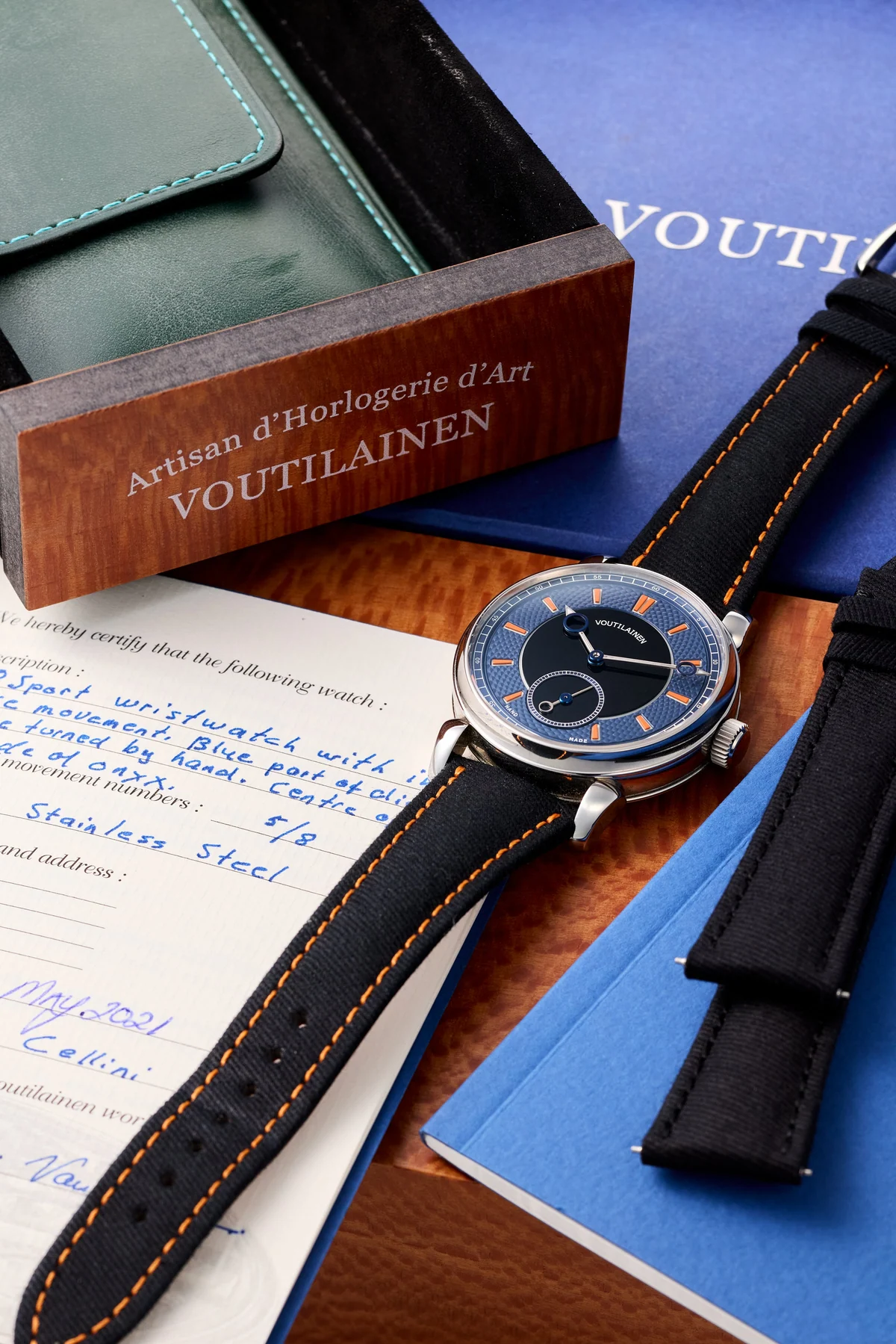
Independent watchmaking produced the widest gaps over estimate. A Théo Auffret Tourbillon à Paris, which the catalogue calls the first of the subscription series to come to auction, carried a high estimate of HK$1.8 million. It was hammered at HK$9.6 million and cost its buyer HK$12,192,000. Phillips lists it as a world auction record for the brand, alongside records for Cédric Johner, Haldimann and Ondřej Berkus.
Where the bidding stopped early
A sale with every lot sold still has weak spots, and the hammer prices show where they are. Phillips’ guide says a reserve will not exceed the low estimate, so a lot can sell under that figure. Fourteen did. In each case the premium lifted the published price back into the estimate range, so none of them looks short on the results sheet.
The largest was lot 1125, a Patek Philippe Ref. 3990P-011 in platinum with a salmon dial, which Phillips describes as possibly unique. It carried the same HK$12 million to HK$24 million estimate as the Ref. 2499. It was hammered at HK$10 million and is listed at HK$12.7 million, which Phillips records as a world auction record for the reference. Both statements are accurate. Only the hammer price shows that bidding ended HK$2 million short of the low estimate.
What to do with a Hong Kong result
For anyone bidding, the estimate is a hammer figure. A winning bid of HK$1 million costs HK$1.27 million before any tax and charges. For anyone consigning or valuing a watch, a published result should be divided back down before it is compared with an estimate or an asking price. For a Hong Kong price up to HK$19.05 million that means dividing by 1.27.
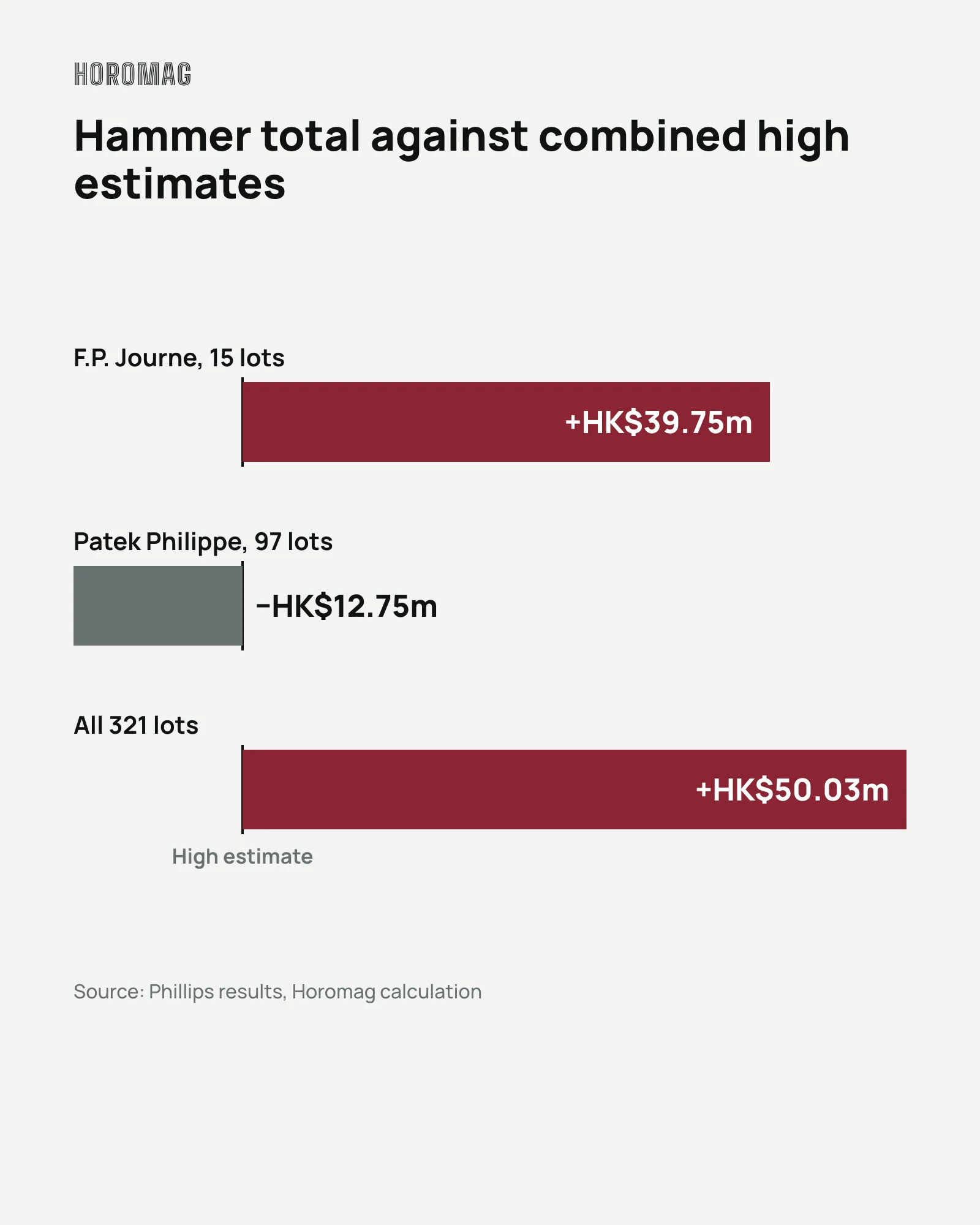
What the Hong Kong record does establish is narrower than the headline and still considerable. Bidders paid HK$443.5 million at the hammer for the 321 lots with a published range, against combined high estimates of HK$393.4 million. That is HK$50 million over, and the surplus is not spread evenly. The 15 F.P. Journe lots in that group were hammered HK$39.75 million above their combined high estimates. The 97 Patek Philippe lots finished HK$12.75 million below theirs, even with lot 958 and a pink gold Ref. 1518 well over. Buyers in Hong Kong paid beyond the estimate for F.P. Journe and for a short list of independents. Of the 97 Patek Philippe lots, 58 were hammered at or below the top of Phillips’ range. Both findings are in the hammer prices, and neither is visible in a total of HK$601 million.

Loading comments...