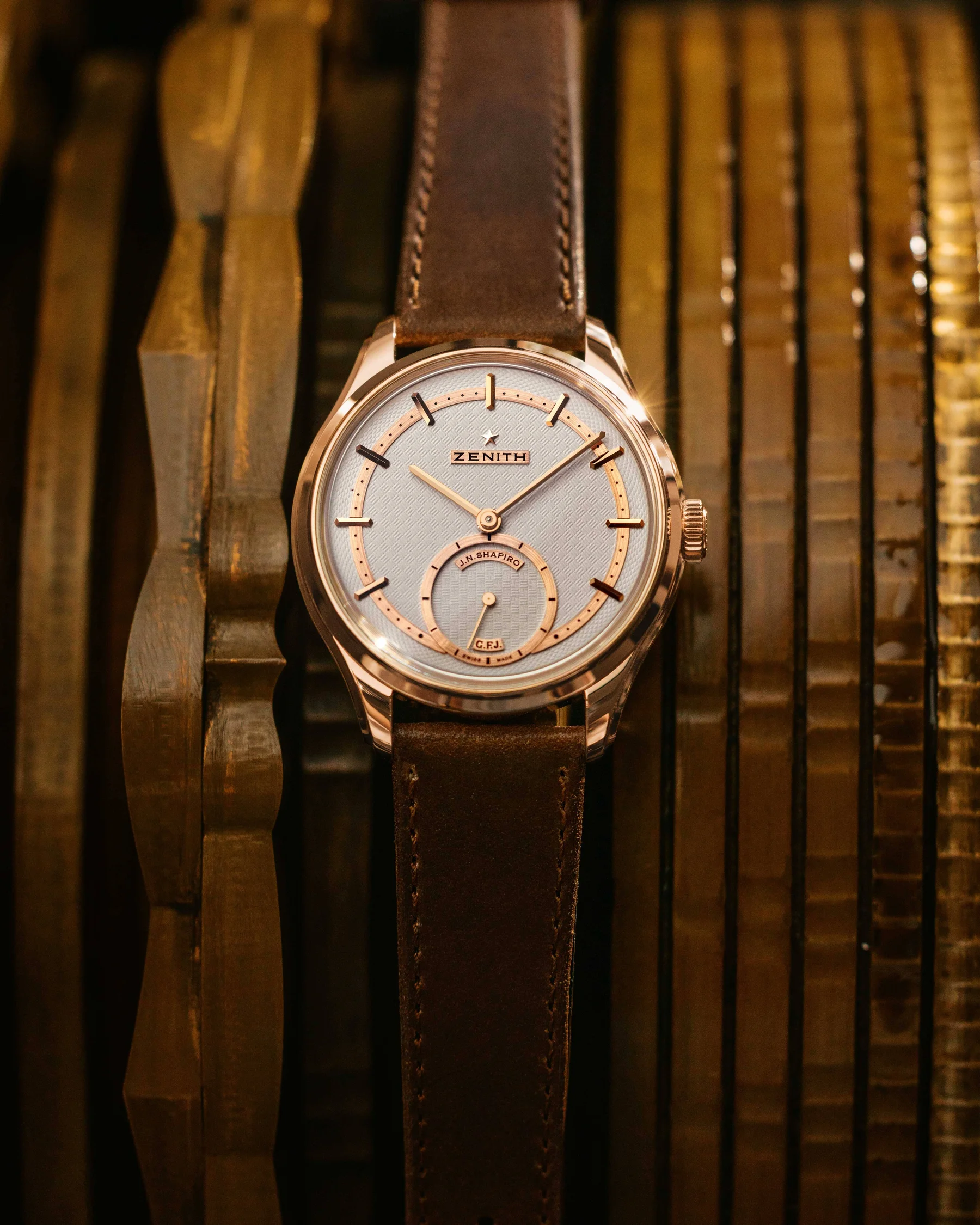
Zenith announced the G.F.J. Calibre 135 Double Signed with J.N. Shapiro on 12 November 2026. The reference is limited to 25 pieces and priced at CHF 68,900. Those numbers establish exclusivity, but they do not explain the watch. The useful collector question is simpler: did Shapiro merely add a name, or change what the owner actually sees? Here, the evidence is on both sides. The dial is made and engine-turned in California, while the visible movement receives a new decorative language developed with the American workshop.
The 30-second collector read
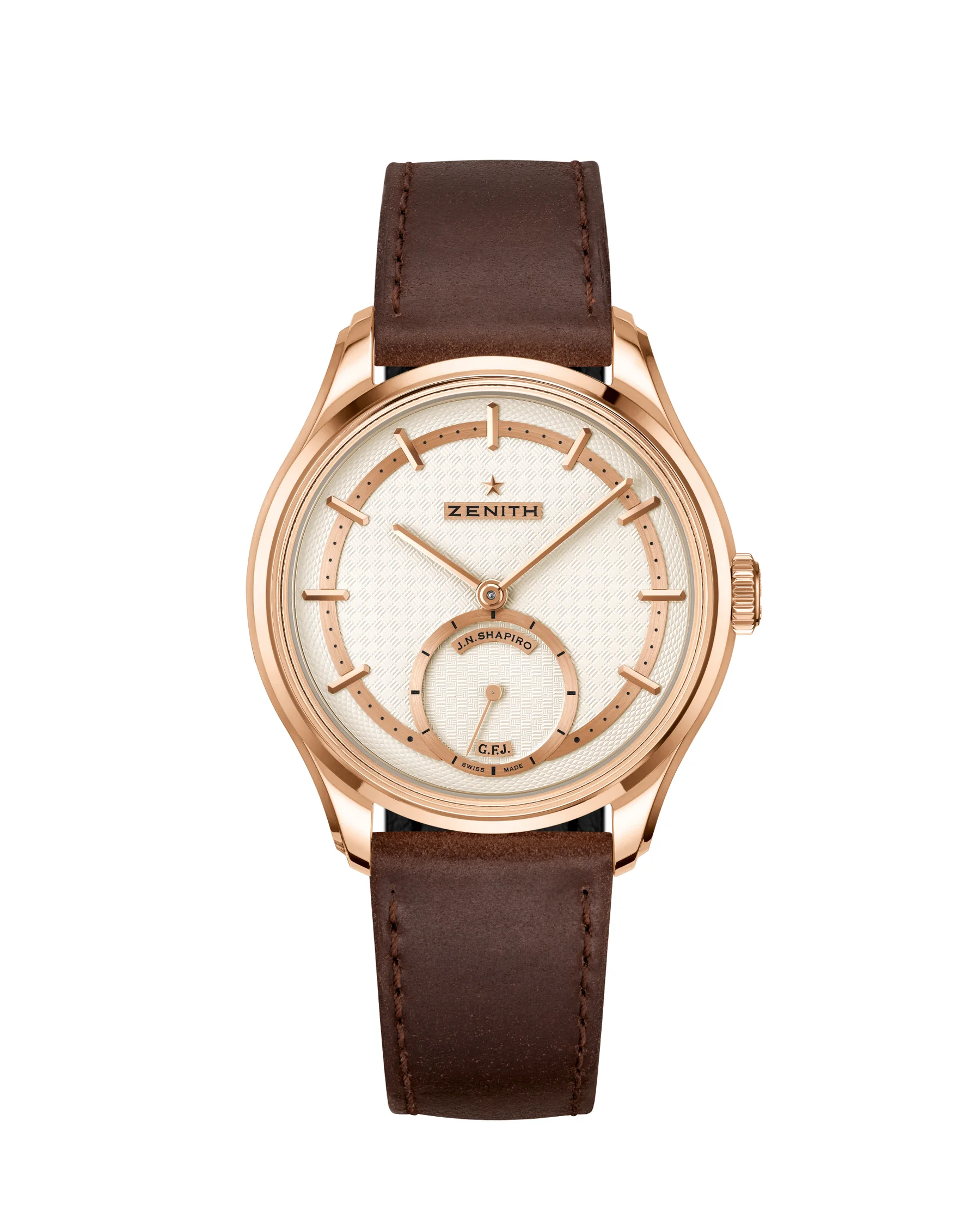
This is a 39.15 mm watch in 18-carat rose gold, powered by the hand-wound Calibre 135. It runs at 18,000 vibrations per hour, offers about 72 hours of reserve and is adjusted to COSC chronometer performance of ±2 seconds per day. Buy into it for the unusually legible division of authorship: Zenith supplies the historic chronometer architecture; J.N. Shapiro changes the dial craft and the movement’s visible finish. Pause if a collaboration must alter the mechanism itself, because Zenith describes the changes as design and finishing work rather than a new calibre architecture.
Three guilloché patterns, one dial hierarchy
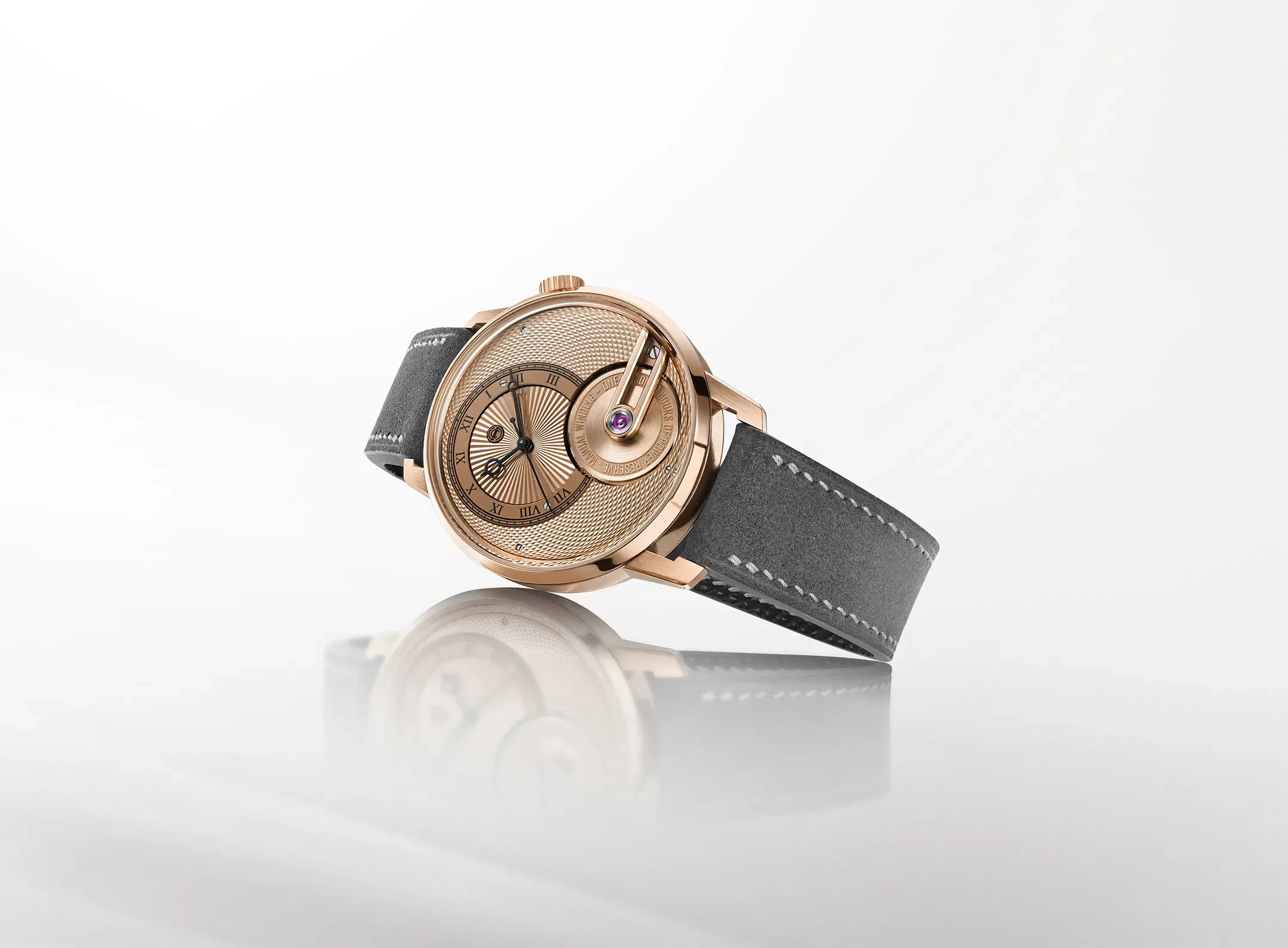
The off-white dial uses three distinct engine-turned patterns. A basketweave occupies the central field, barleycorn frames the perimeter and an infinity weave fills the small seconds. Rose-gold chapter rings, applied markers and hands keep the tonal range narrow. The result matters because multiple patterns can easily become a sample board. Here they instead define reading zones: hours and minutes remain dominant, while the seconds register becomes a smaller demonstration of Shapiro’s craft. The J.N. Shapiro signature follows the arc of the small-seconds bridge rather than competing with Zenith at 12.
The American contribution continues on the movement
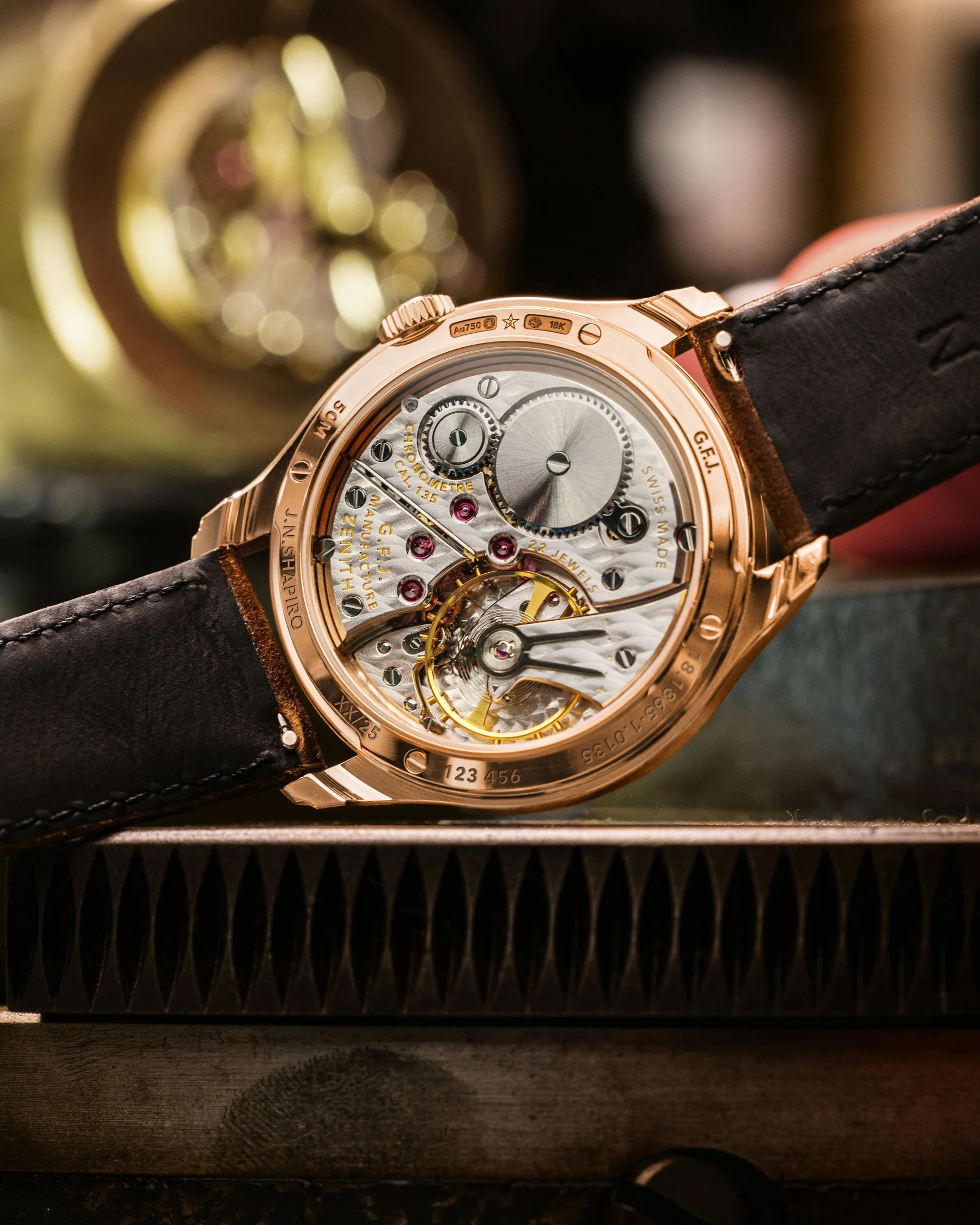
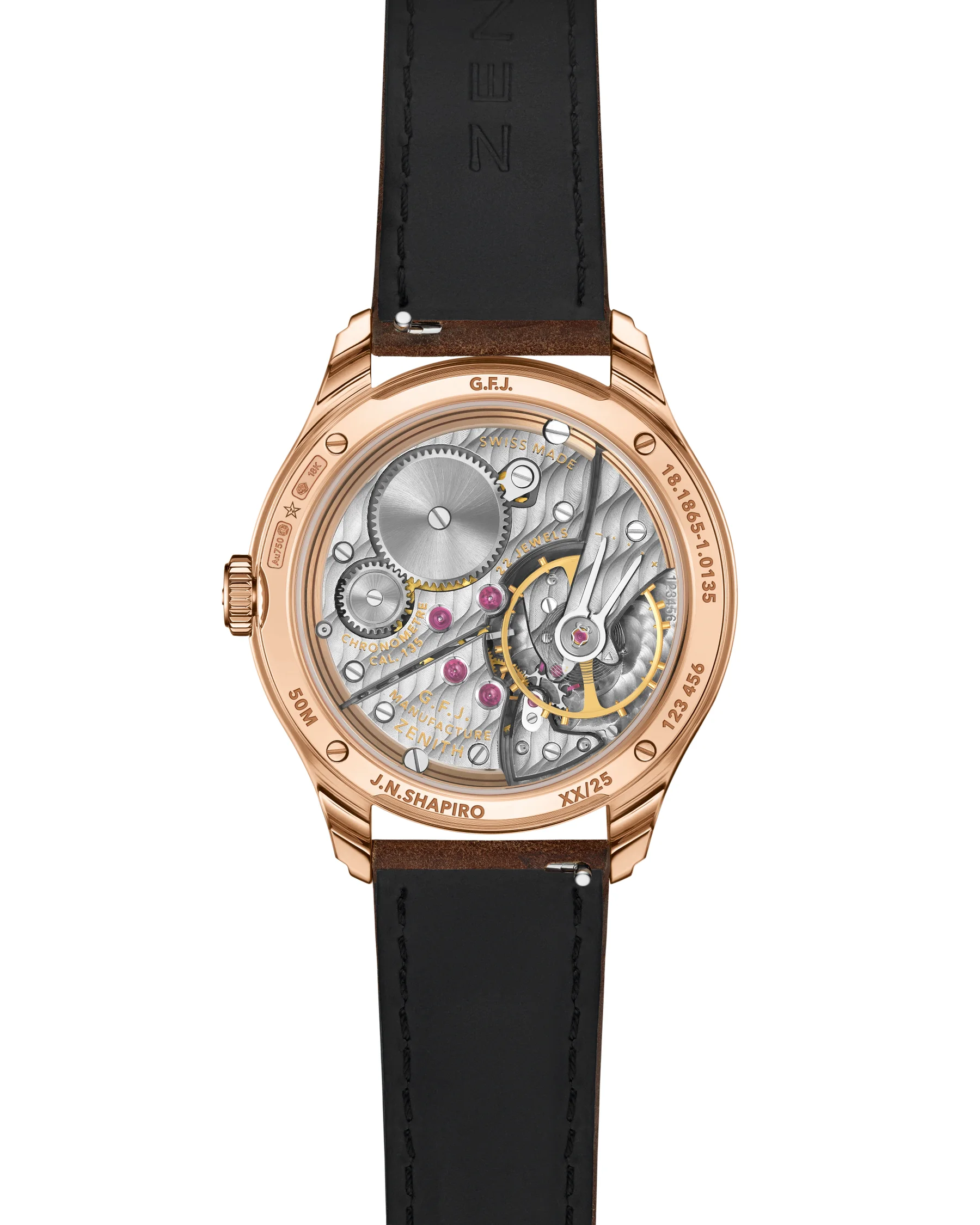
The caseback is the stronger argument for calling this a collaboration. Calibre 135 keeps its slow 2.5 Hz beat, large balance and hand-wound layout, but its bridges carry a damaskeening pattern associated with American decorative metalwork. Polished bevels, gold-filled engravings and the open architecture allow that surface to be read rather than hidden. The two names on the case rim identify responsibility, yet the finish itself is the more persuasive signature. It gives the familiar Zenith calibre a texture that does not appear on the standard G.F.J.
What remains unmistakably Zenith
The dimensions, movement fundamentals and chronometer claim remain rooted in the G.F.J. programme. The 39.15 mm rose-gold case is 10.5 mm thick and rated to 5 ATM. Calibre 135 has 23 jewels, stop seconds and a 72-hour reserve. Its 18,000-vph rate is not a modern high-frequency flex; it is part of the architecture Zenith revived from its mid-century observatory-chronometer history. The collaboration therefore works by changing the surfaces through which that history is encountered, not by pretending the underlying machine belongs to someone else.
The CHF 68,900 decision
At CHF 68,900 and 25 pieces, this is not a general recommendation. A prospective owner should compare it with the standard G.F.J., inspect the guilloché under neutral light and decide whether the American workshop’s contribution is visible enough to justify the collaboration premium. Zenith’s announcement supports the price, limitation and specifications, but not future demand, allocation difficulty or investment performance. The watch succeeds on a narrower test: remove either name and the object would lose a specific body of work. That is what makes this double signature credible.
Loading comments...