
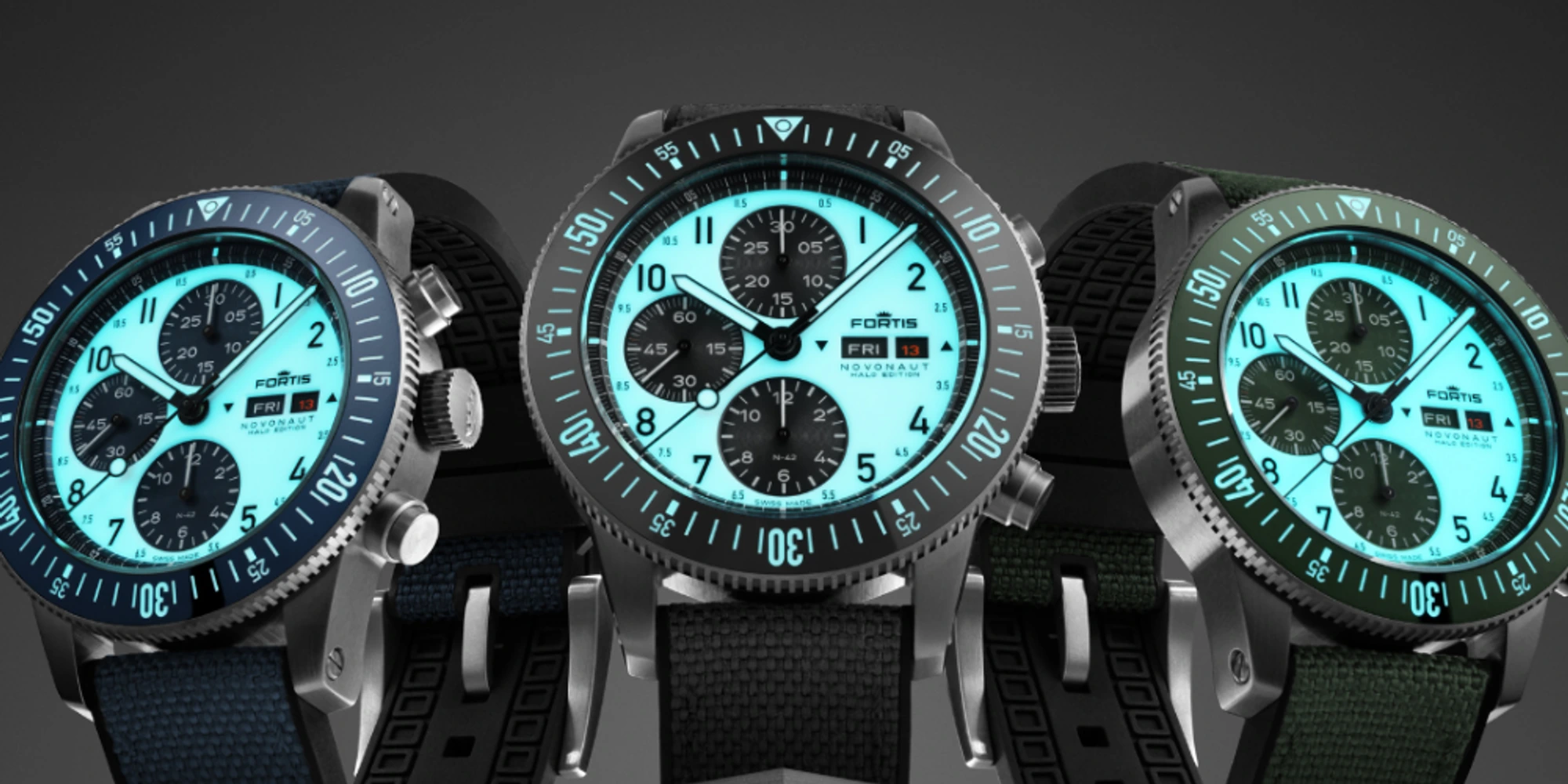
Fortis has introduced the Novonaut Halo in Black, Blue and Green, but the important change is not the colour choice. The complete base dial is made from Lumicast X1, while the chronograph counters stay dark. In daylight, the watches read as familiar panda chronographs. In darkness, the relationship reverses: the dial becomes the bright field and the counters become negative space. A luminous ceramic bezel carries that contrast beyond the dial. This is more than adding brighter markers. It reorganises the information architecture of a chronograph when ambient light disappears.
Why a collector should care
Lume is often treated as a specification to rank: brighter, longer, or more heavily applied. The Halo is more interesting because it uses luminous material to decide which layers of information remain dominant. The hour track and hands stay legible against a glowing field, while the dark counters retain their shape without competing for attention. For a collector, the question is whether this reversal improves fast reading or simply creates a dramatic display. It is the kind of feature that should be judged after a full charge and several hours in darkness, not from a launch photograph alone.
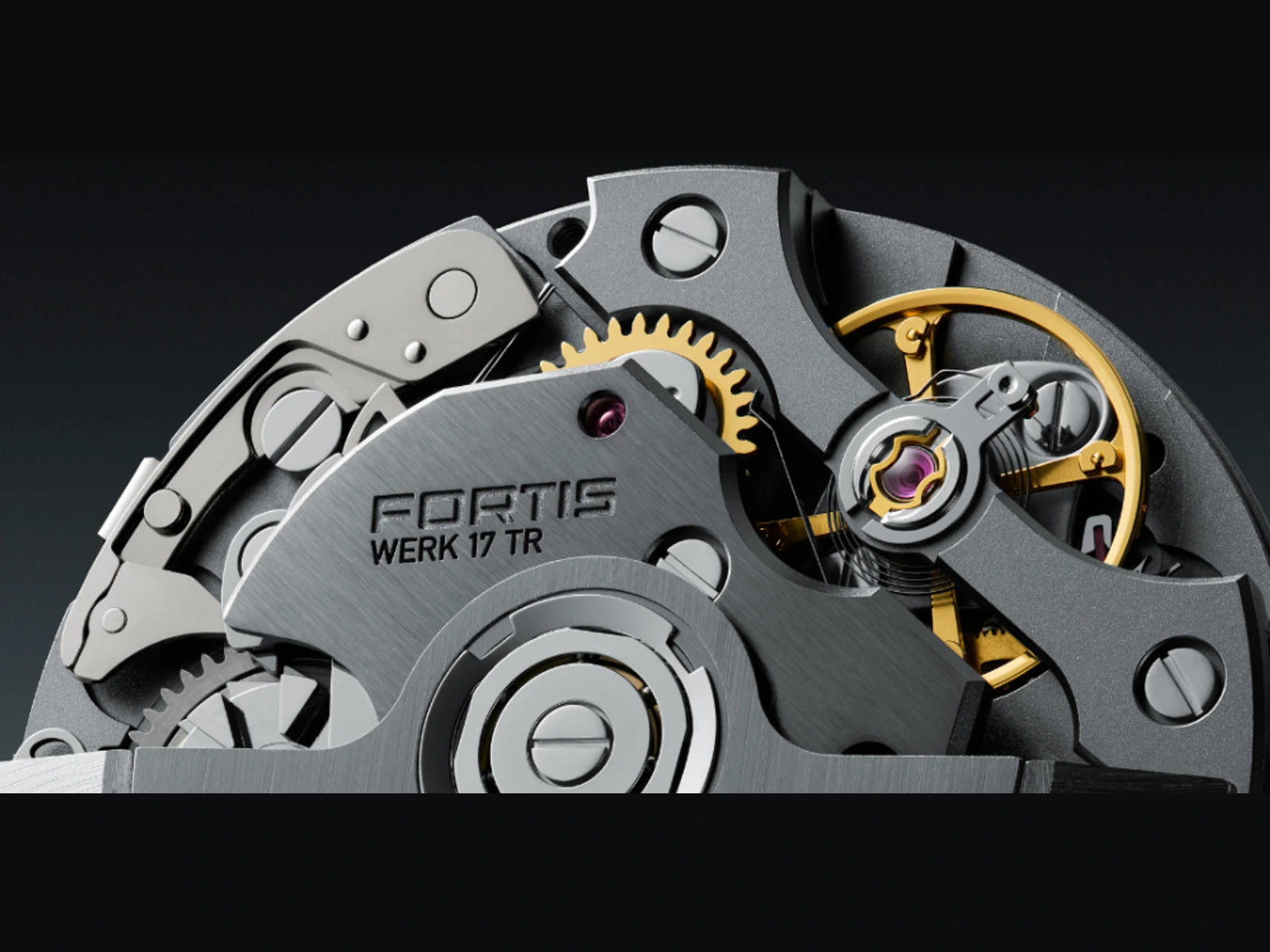
Werk 17 TR is the deeper update
Inside sits the new automatic column-wheel chronograph Werk 17 TR. Fortis specifies a 70-hour power reserve, a free-sprung variable-inertia balance and two-point fixation around the balance assembly. TR stands for Trägheitsregulierung: regulation is performed by changing the inertia of the balance rather than by moving a conventional regulator. In practical terms, that architecture aims to keep the effective hairspring length fixed and to make the regulating organ more resistant to disturbance. Fortis also says the two-point support improves stability and shock resistance. Those are brand claims until independent timing and service evidence accumulates, but the design choices are technically coherent for a tool chronograph.
Space-tested is not the same as moon-proven
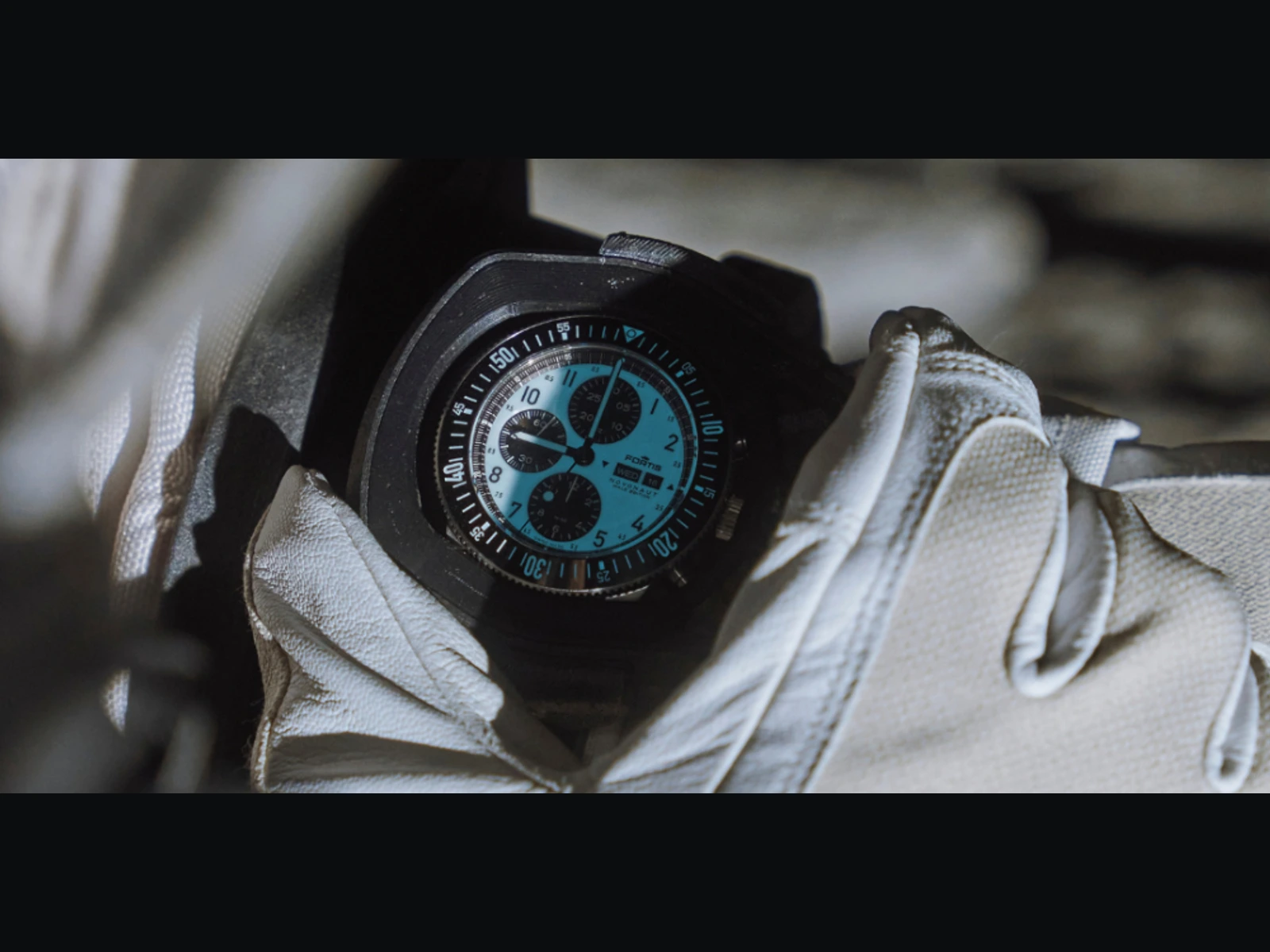
Fortis says the technical basis of Werk 17 was tested first on a stratospheric mission with the Swedish Space Corporation and later on a rocket flight. The new Halo also appears in a separate programme with Norway’s Nåva Space, which is developing a next-generation spacesuit for future lunar missions. The watch is being integrated as an independent mechanical time reference that needs no network, satellite link or external power. That is meaningful development context, but it should not be inflated into a claim that the Halo has already operated on the Moon. The distinction keeps the engineering story credible.
What the launch still does not tell us
The official announcement describes the three colourways, luminous architecture and movement, but it does not yet provide exact retail references, case dimensions, prices or a regional availability schedule. Those omissions matter. Full-dial lume can be compelling, yet a buyer still needs to know case fit, chronograph pusher feel, service terms and whether the coloured dial remains restrained in daylight. Until product pages and retail watches appear, this is a design-and-calibre assessment rather than a buying recommendation.
The collector test
The Novonaut Halo works as an idea because its two main changes point in the same direction. The dial pursues readable contrast when conditions deteriorate; Werk 17 TR pursues a more stable regulating architecture when the watch is disturbed. Collectors should resist the easy “space watch” headline and examine those two systems instead. If the real watch preserves clean daytime legibility, useful overnight glow and dependable chronograph operation, the Halo will be more than a photogenic lume experiment. The next evidence should come from wrist fit, measured timing and long-duration darkness—not from a louder slogan.




Loading comments...